
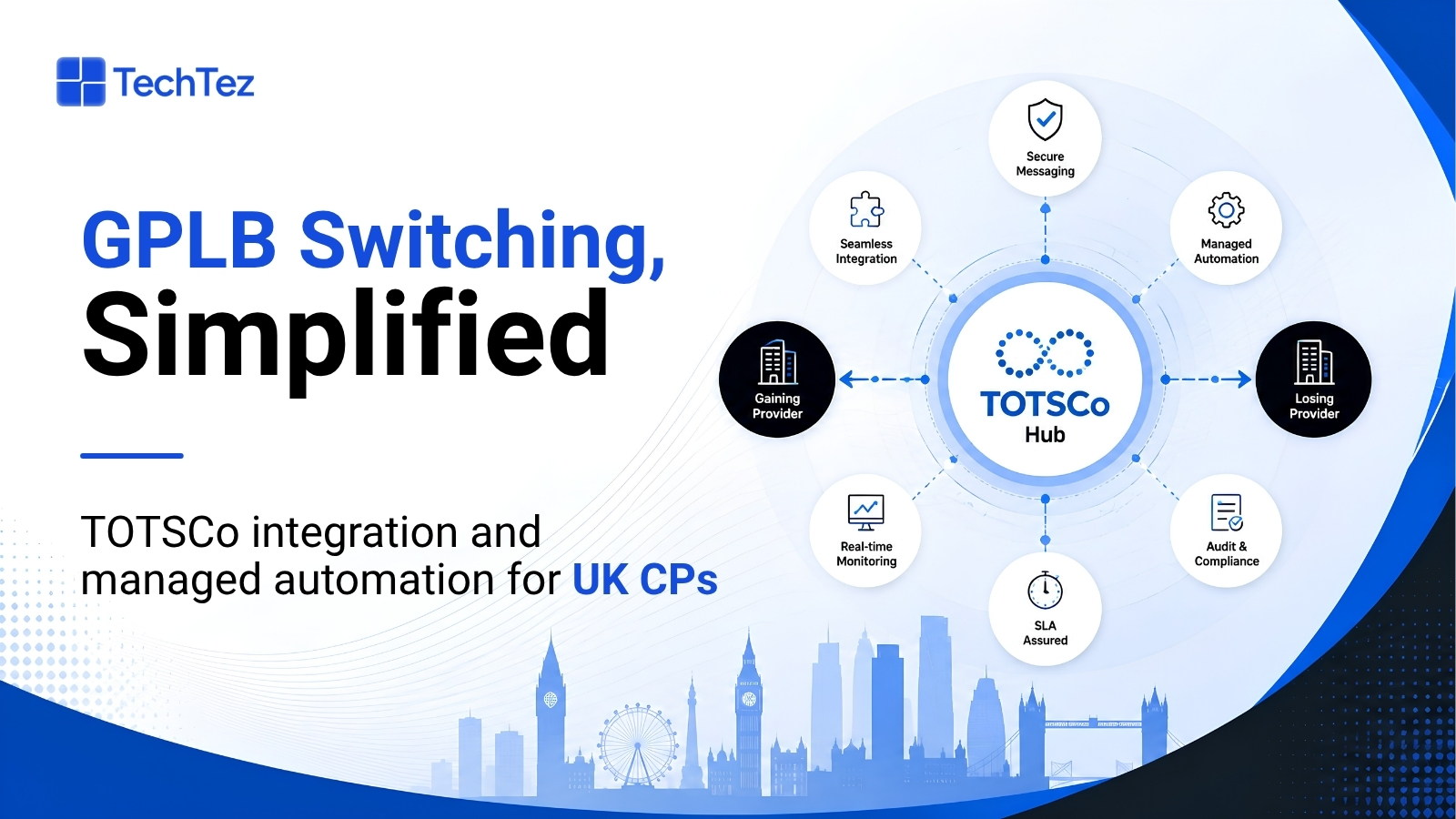

GPLB (Gaining Provider Led Business) switching is the UK framework that enables Communications Providers (CPs) to manage business broadband switching through a standardized, gaining-provider-led process. Built on TOTSCo’s secure messaging platform, it simplifies provider-to-provider communication, reduces manual coordination, and helps deliver a more consistent switching experience for business customers.
Built on TOTSCo’s Business Switching framework,it simplifies provider-to-provider communication, reduces manual coordination, and helps deliver a more consistent switching experience for business customers.GPLB addresses these challenges by providing a standardized process that enables Communications Providers to exchange information securely and efficiently. As the UK’s telecom industry expands its switching framework beyond residential services, understanding GPLB is becoming increasingly important for providers preparing for future operational and regulatory requirements.
Why GPLB Switching Matters
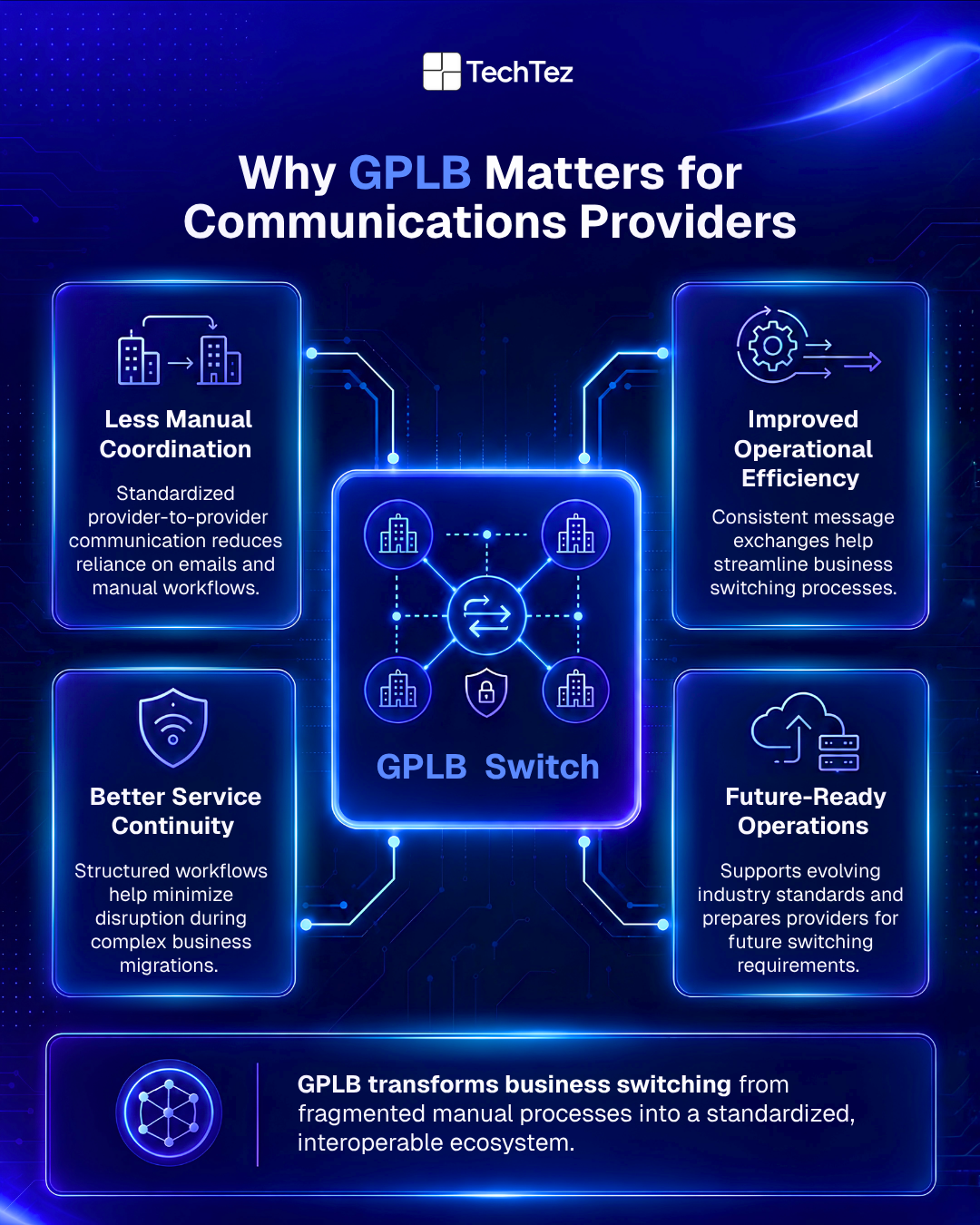
GPLB switching provides a standardized framework for business broadband switching, enabling Communications Providers to exchange switching information securely through TOTSCo’s messaging platform. By reducing manual coordination and streamlining provider-to-provider communication, it helps deliver faster, more consistent, and more reliable business switching.
Business broadband powers critical services such as cloud applications, VoIP systems, hybrid work environments, and cybersecurity solutions, making service continuity essential. Unlike residential switching, business migrations often involve multiple service locations, contractual commitments, and more complex infrastructure, increasing the risk of delays and operational disruption.
GPLB addresses these challenges by replacing fragmented, manual processes with a standardized switching framework. Through TOTSCo’s messaging platform, Communications Providers can coordinate switching requests more efficiently, improve operational visibility, and deliver a smoother experience for business customers while supporting compliance with industry requirements
Why was GPLB introduced?
Business broadband switching has traditionally been more complex than residential switching. Unlike residential customers, businesses often rely on multiple broadband connections, voice services, leased infrastructure, and site-specific configurations to support day-to-day operations. Switching providers frequently involved manual coordination between the customer, the gaining provider, and the losing provider, making the process time-consuming and prone to delays.
These manual processes often resulted in inconsistent customer experiences, administrative overhead, longer provisioning times, and a greater risk of errors. Business customers were sometimes required to coordinate service termination dates, validate account information, and manage communications between multiple parties, increasing the likelihood of service disruption.
GPLB was introduced to support Ofcom’s broadband switching reforms, providing a standardized, gaining provider-led framework for business broadband switching that improves coordination between Communications Providers.Through TOTSCo’s secure messaging platform, Communications Providers can exchange switching information electronically using consistent industry-defined processes rather than relying on fragmented manual workflows. This improves coordination, increases transparency, and helps reduce operational complexity throughout the switching journey.
For Communications Providers, GPLB offers a more scalable approach to managing business switches. By standardizing message exchanges and reducing manual intervention, providers can improve operational efficiency, support regulatory compliance, and deliver a more reliable switching experience while continuing to differentiate themselves through customer service, innovation, and commercial offerings.
How GPLB Switching works
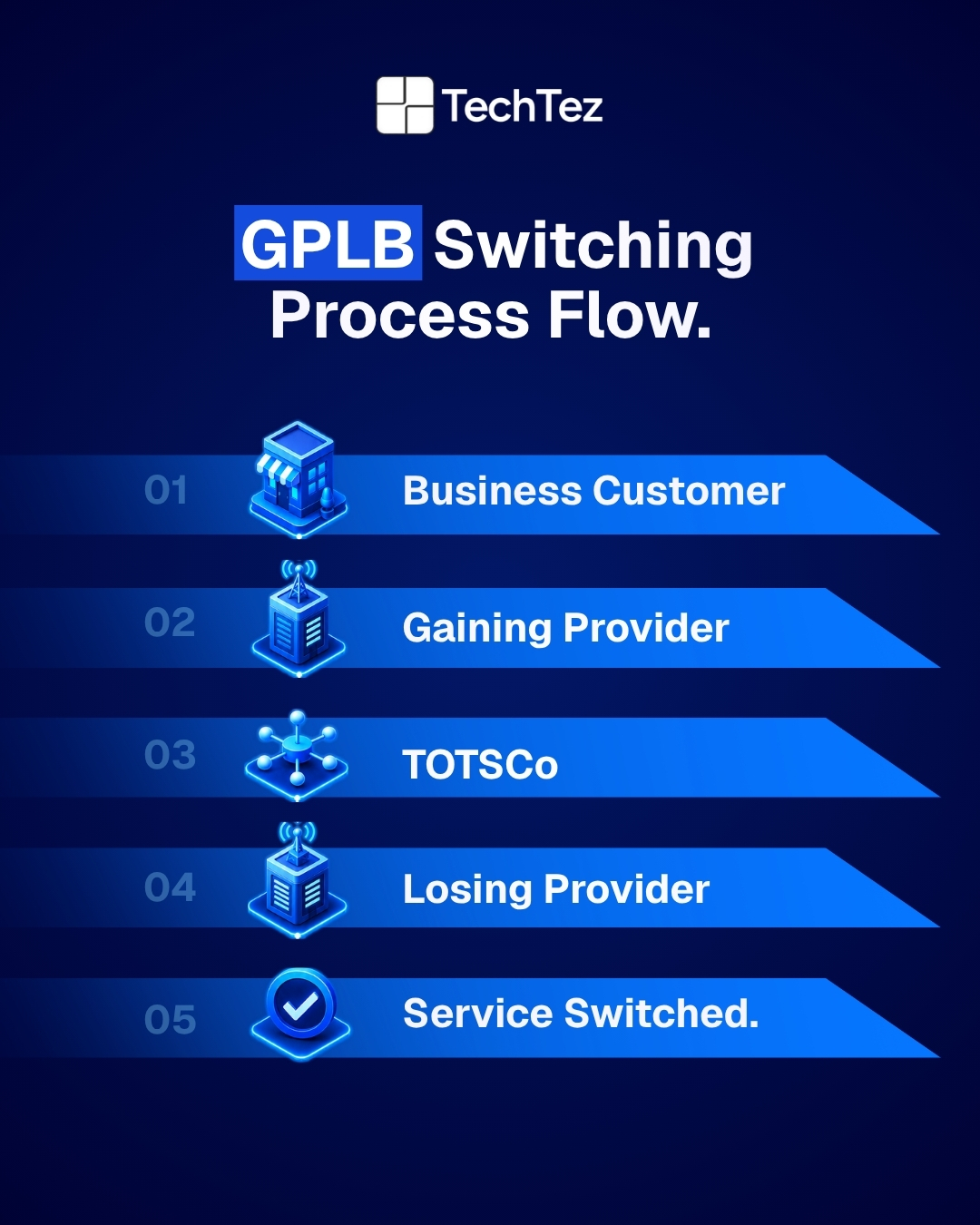
GPLB follows a structured, gaining provider-led process designed to make business broadband switching more efficient and transparent. Unlike traditional switching, where customers often had to coordinate with multiple providers, GPLB places the responsibility on the gaining provider. The two Communications Providers exchange standardized messages through TOTSCo’s messaging platform, while the customer interacts primarily with the provider they are moving to.
Although the exact journey may vary depending on the services involved, a typical GPLB switch follows these five stages.
Step 1: Customer Requests to Switch
The process begins when a business decides to switch its broadband or voice services to a new Communications Provider. The customer contacts the gaining provider and provides the information needed to identify the existing service. From this point onward, the gaining provider takes ownership of managing the switching journey.
Step 2: Service Validation
Before submitting the switching request, the gaining provider validates the customer’s service details to confirm the correct service has been identified and that the switch is eligible to proceed. Early validation helps identify potential issues before they affect the migration, reducing delays and failed switching requests.
Step 3: Secure Message Exchange
Once the request is validated, the gaining and losing providers exchange standardized switching messages through the TOTSCo Hub. These messages include customer and service verification, switching requests, status updates, exceptions, and completion notifications. Using a common messaging framework improves consistency and reduces reliance on manual communication.
Step 4: Switching Coordination
As the switch progresses, both providers continue exchanging messages to confirm timelines, process updates, resolve exceptions, and coordinate the service migration. Standardized workflows improve operational efficiency and provide better visibility throughout the switching process.
Step 5: Service Completion
Once all required checks and coordination activities are complete, the customer’s services are transferred to the gaining provider. The result is a more streamlined switching experience for business customers and a more efficient, standardized process for Communications Provider.
Who Is Involved in GPLB Switching?
GPLB switching is a collaborative process that involves multiple participants working together to ensure a business broadband or voice service is transferred efficiently. Unlike traditional switching, where customers often had to coordinate with both their current and new providers, GPLB clearly defines the responsibilities of each party. The business customer, the gaining provider, the losing provider, and TOTSCo each play a distinct role in ensuring switching requests are processed securely, accurately, and with minimal disruption.
Business Customer
The process begins when a business customer decides to switch to a new Communications Provider. The customer simply contacts the provider they wish to move to and provides the necessary service information. From that point onward, they no longer need to coordinate separately with their existing provider, making the switching journey simpler, more transparent, and less time-consuming.
Gaining Communications Provider
The Gaining Communications Provider is responsible for leading the switching process. It collects and validates customer information, confirms service eligibility, initiates switching requests through the TOTSCo Hub, monitors progress, and keeps the customer informed throughout the migration. Acting as the primary point of contact, the GCP helps simplify the customer experience while ensuring the switch progresses efficiently.
Losing Communications Provider
The Losing Communications Provider supports the switching process by receiving and responding to standardized messages exchanged through the TOTSCo Hub. It validates existing service details, processes switching requests where required, and works with the gaining provider to ensure a smooth and accurate transfer of services. This coordinated approach helps reduce delays and maintain service continuity.
TOTSCo
TOTSCo (The One Touch Switching Company) provides a secure messaging infrastructure that enables Communications Providers to exchange standardized switching information. While it does not manage customer accounts or perform the switch itself, it ensures providers can communicate using a common framework, improving interoperability, reducing manual processes, and supporting a more efficient switching ecosystem across the UK telecom industry.
Where does a Managed Access Platform (MAP) fit in?
While TOTSCo provides the secure messaging framework for business switching, Communications Providers still need a practical way to connect to the platform, exchange messages, and manage day-to-day switching operations. Building and maintaining a direct integration requires technical expertise, ongoing maintenance, and operational resources. For many providers, especially those with limited in-house capabilities, this can add complexity to the implementation process.
A Managed Access Platform (MAP) acts as the operational layer between a Communications Provider and the TOTSCo Hub. Rather than developing and maintaining a direct connection, providers can use a MAP to simplify integration and manage the operational aspects of switching. Depending on the service model, a MAP may support secure connectivity, message exchange, onboarding, testing, transaction monitoring, reporting, and ongoing operational management.
For small and mid-sized Communications Providers, a managed approach can reduce implementation effort, accelerate onboarding, and simplify ongoing operations. It also allows internal teams to focus on delivering customer services while relying on a standardized platform to support secure, compliant, and efficient switching through the TOTSCo ecosystem.
GPLB Switching vs Residential One Touch Switch(OTS)
GPLB and One Touch Switch (OTS) share the same objective of simplifying switching but serve different customer groups and operational requirements.
GPLB Switching | One Touch Switch |
Designed for business broadband services | Designed for residential broadband customers |
Supports more complex business service scenarios | Primarily supports consumer broadband switching |
May involve additional validation and coordination | Simpler switching process |
Built around TOTSCo messaging standards | Also uses TOTSCo messaging framework |
Focus on business continuity and operational coordination | Focus on improving consumer switching experience |
Business services often involve multiple locations, dedicated connectivity, contractual commitments, or integrated voice and data solutions. As a result, GPLB processes typically demand more detailed validation and coordination than residential switching.
Common Challenges in GPLB Switching
Implementing GPLB requires Communications Providers to align technology, processes, and teams with evolving industry requirements. Preparing for these challenges early can help providers identify integration gaps, strengthen operational workflows, and improve overall switching readiness.
A proactive approach also enables teams to manage exceptions, maintain compliance, and deliver consistent customer experiences throughout the switching journey. By investing in scalable systems, clear processes, effective monitoring, and operational training, providers can reduce implementation risks, minimize delays, and improve efficiency. Building a flexible switching capability today also helps Communication Providers adapt to future business switching requirements and industry changes without significant operational disruption.
Adapting to New Messaging Standards
- Establish secure connectivity: Connect securely with the TOTSCo Hub and ensure reliable communication throughout the switching journey.
- Support standardized messaging: Update existing systems and integrate industry-defined APIs to generate, process, and respond to switching messages accurately.
- Modernize legacy infrastructure: Identify gaps in older systems and improve interoperability where existing platforms cannot support the required messaging standards.
- Strengthen security and monitoring: Implement authentication, certificate management, error handling, transaction monitoring, and appropriate controls for secure operations.
- Test before going live: Conduct comprehensive connectivity, message-flow, and end-to-end testing to identify issues and reduce switching failures.
Managing Operational Exceptions
- Identify exceptions early: Use validation checks and transaction monitoring to detect incomplete customer information, service mismatches, and other issues.
- Maintain end-to-end visibility: Track message status and switching progress across every stage of the journey.
- Standardize exception handling: Establish clear workflows for managing validation failures, contractual constraints, cancellations, and other exceptions.
- Reduce manual intervention: Automate repetitive validation and exception-handling activities wherever possible to improve efficiency.
- Resolve issues quickly: Give operational teams the tools and information needed to investigate problems, coordinate across systems, and keep switching requests on track.
Maintaining Regulatory Compliance
- Monitor regulatory changes: Regularly review evolving switching requirements, industry standards, and regulatory obligations.
- Review internal processes: Assess systems, workflows, and operational procedures to ensure they remain aligned with current requirements.
- Build adaptable processes: Design flexible workflows that can accommodate future regulatory and industry changes with minimal disruption.
- Automate compliance activities: Use automated workflows, validations, and reporting to reduce operational complexity and improve consistency.
- Maintain operational resilience: Build scalable switching capabilities that support compliance, service reliability, business continuity, and future requirements.
Delivering a Better Customer Experience
- Provide timely updates: Keep business customers informed about switching progress, key milestones, and potential delays.
- Improve process visibility: Give internal teams clear visibility into switching status so customer enquiries can be addressed quickly.
- Reduce avoidable delays: Standardize workflows and automate repetitive activities to keep switching requests moving efficiently.
- Resolve issues proactively: Identify exceptions early and ensure the right teams can address them before they significantly impact customers.
- Build customer confidence: Combine reliable processes, proactive communication, and consistent service delivery to create a predictable and minimally disruptive switching experience.
Choosing the Right GPLB integration Approach
Communications Providers can connect to the GPLB ecosystem in two ways: by building a direct integration with the TOTSCo Hub or by using a Managed Access Platform (MAP). The right approach depends on factors such as technical expertise, available resources, implementation timelines, and long-term operational goals. While direct integration offers greater control, a managed approach can simplify implementation and reduce the ongoing operational effort.
Option 1: Direct Integration
Building a direct integration with the TOTSCo Hub gives Communications Providers complete control over their switching environment. However, it also means taking responsibility for the entire integration lifecycle, including:
- API development and system integration
- Infrastructure and security management
- Testing and onboarding
- Transaction monitoring and reporting
- Ongoing maintenance and platform updates
- Adapting to evolving regulatory and industry requirements
- Operational support and issue resolution
This approach is typically best suited to larger Communications Providers with dedicated engineering teams and the resources to manage integration and ongoing operations in-house.
Option 2: Managed Access Platform (MAP)
A Managed Access Platform (MAP) enables Communications Providers to connect to the GPLB ecosystem without building and maintaining a direct integration. Instead, providers use a managed environment that simplifies connectivity and supports the operational aspects of business switching.
A managed approach can provide benefits such as:
- Faster onboarding and implementation
- Reduced technical complexity
- Centralized monitoring and operational dashboards
- Simplified message exchange and management
- Ongoing platform maintenance and support
- Easier adaptation to changing industry standards and regulatory requirements
For many small and medium-sized Communications Providers, a MAP offers a practical way to accelerate deployment while reducing the burden on internal teams. This allows organizations to focus on delivering high-quality customer experiences instead of managing the complexities of switching infrastructure.
Best Practices for GPLB Readiness
A successful GPLB implementation requires organizations to evaluate their existing systems, operational workflows, and team capabilities. Internal platforms such as CRM, billing, provisioning, and customer management systems must be prepared to handle standardized message exchanges and support seamless data flow throughout the switching journey. Clear operational processes should also be established to manage customer requests, handle exceptions, monitor transactions, and resolve issues quickly.
Understand the End-to-End Switching Journey
Communication Providers should map every stage of the switching lifecycle, from customer initiation and request validation to service activation and completion. This includes identifying key workflows, system interactions, dependencies, and the responsibilities of different teams involved in the process.
Having a well-defined switching journey helps organizations identify potential bottlenecks, reduce process gaps, and improve coordination between business and technical teams. It also enables faster troubleshooting by providing clear visibility into where delays or failures may occur.
By documenting each step and establishing standardized processes, providers can ensure consistent handling of switching requests, improve operational efficiency, and create a smoother experience for both customers and internal teams. A comprehensive understanding of the switching journey forms the foundation for a reliable, scalable, and compliant switching operation.
Prepare Internal Systems
Communication Providers need to assess the readiness of core systems, including CRM, provisioning, billing, order management, and operational support platforms, to support standardized switching workflows and message exchanges.
Early identification of integration gaps, data inconsistencies, or process limitations helps organizations address potential challenges before they impact live operations. System readiness ensures that customer information flows accurately between platforms, reduces manual intervention, and improves overall transaction reliability.
Providers should also evaluate their existing architecture to ensure scalability, security, and flexibility for future industry changes. By strengthening system integrations and aligning internal platforms with GPLB requirements, organizations can simplify implementation, minimize operational disruptions, and deliver a more efficient switching experience for customers and operational teams.
Train Operational Teams
Customer support, provisioning, and operational teams need a clear understanding of switching workflows, responsibilities, and escalation procedures to manage requests effectively.
Providing comprehensive training enables teams to respond confidently to customer enquiries, identify issues quickly, and resolve exceptions without unnecessary delays.
Regular knowledge updates and process training help maintain consistency across teams and reduce dependency on individual expertise. By empowering operational teams with the right skills and information, Communication Providers can improve service quality, enhance customer satisfaction, and ensure a smoother switching experience aligned with industry expectations.
Monitor Performance
Communication Providers should track key performance indicators such as transaction processing times, successful completion rates, exception volumes, failure reasons, and SLA compliance to gain visibility into operational performance.
Regular analysis of operational data also supports compliance management and helps providers optimize workflows over time. By establishing proactive monitoring practices, organizations can improve reliability, reduce delays, and maintain consistent service quality. A data-driven approach ensures switching operations remain efficient, scalable, and capable of meeting evolving business and customer expectations.
Choose the Right Integration Strategy
Selecting the right integration strategy is a key decision when implementing GPLB switching capabilities. Communication Providers need to evaluate whether a direct integration approach or a Managed Access Platform (MAP) better aligns with their technical capabilities, operational resources, and long-term objectives.
Direct integration may provide greater control but often requires significant investment in development, maintenance, compliance management, and ongoing operational support. A Managed Access Platform can simplify connectivity by providing pre-built integrations, standardized workflows, and operational support while reducing implementation complexity.
The right approach depends on factors such as existing infrastructure, scalability requirements, internal expertise, and future business plans. Evaluating these considerations early helps providers avoid unnecessary complexity, accelerate deployment, and build a switching environment that can adapt to changing industry requirements while supporting long-term operational efficiency.
Conclusion
GPLB switching represents an important step forward in modernizing business broadband switching across the UK. By introducing standardized messaging through TOTSCo and placing the gaining provider at the center of the switching journey, the framework helps create a more consistent, transparent, and efficient experience for communications providers and business customers alike.
As switching requirements continue to evolve, providers that invest in scalable processes, effective monitoring, and the right integration strategy will be better positioned to deliver seamless customer experiences while improving operational efficiency.
Whether organisations choose to build a direct integration or adopt a Managed Access Platform, preparing early and establishing reliable operational workflows will be key to long-term success.