
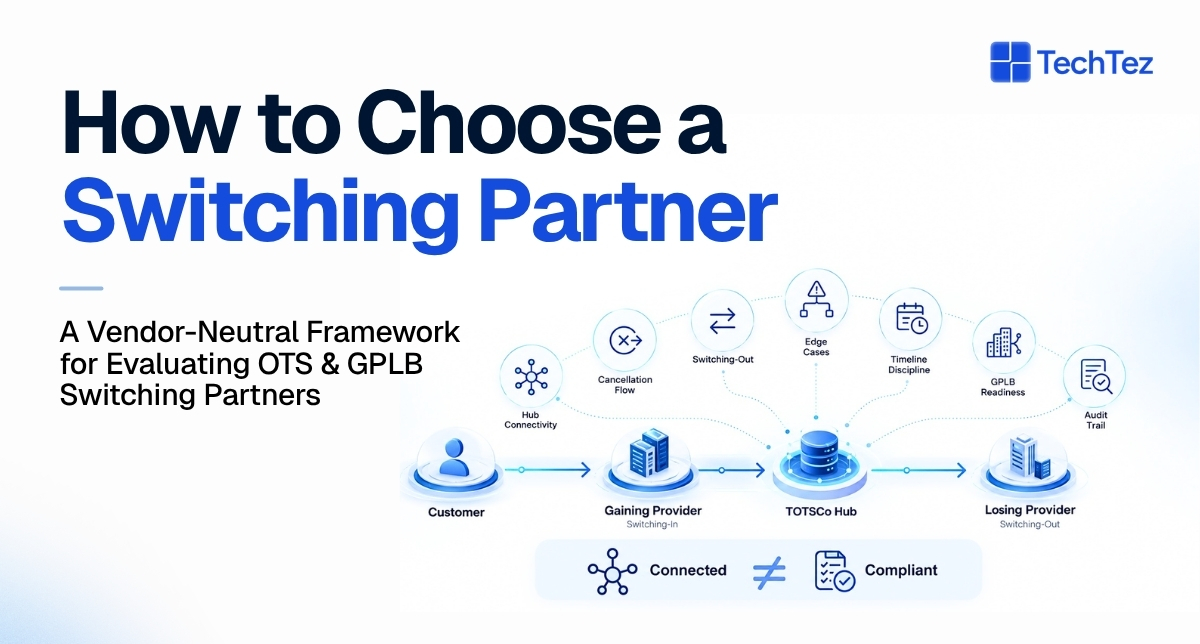

Most communications providers pick a switching partner based on one question: are they connected to the Hub? That’s not enough, and Ofcom just proved it. Before you sign with anyone, look past their Hub connection. Check their cancellation flow for hidden “Cancel Other” workarounds. Make sure they handle switching-out as carefully as switching-in. Confirm they’ve actually dealt with tricky cases like voice services, number porting, and bundled add-ons. And ask about their track record on deadlines and business switching, not just residential.
Virgin Media was connected to the Hub. That still cost them £28 million. That’s the whole reason this framework exists. Being technically connected to TOTSCo’s Hub was never the real test of compliance. What actually mattered, according to Ofcom, was whether customers could leave without a fight. Ofcom’s July 2026 ruling against Virgin Media made that distinction painfully clear, and it’s the standard every provider should hold a switching partner to now, whether you’re dealing with residential OTS or the newer GPLB rules for business.
Why Vendor choice matters more than the Hub Connection
Every partner selling switching services today will claim Hub connectivity. That claim is the floor, not the differentiator. Ofcom’s own enforcement record shows a provider can be technically connected and still fail the standard that actually matters: whether a real customer, on a real call, experiences a switch or a cancellation as simple. A vendor-neutral evaluation starts by discounting the connectivity claim entirely and asking what happens underneath it, spec discipline, cancellation design, edge-case handling, and timeline honesty. This isn’t an academic distinction. It’s the difference between a partner you find out is inadequate during a routine audit and one you find out is inadequate during an Ofcom inquiry. Everything below is built to surface those differences before you sign, not after.
Hub Connectivity is the Floor, Not the Finish Line
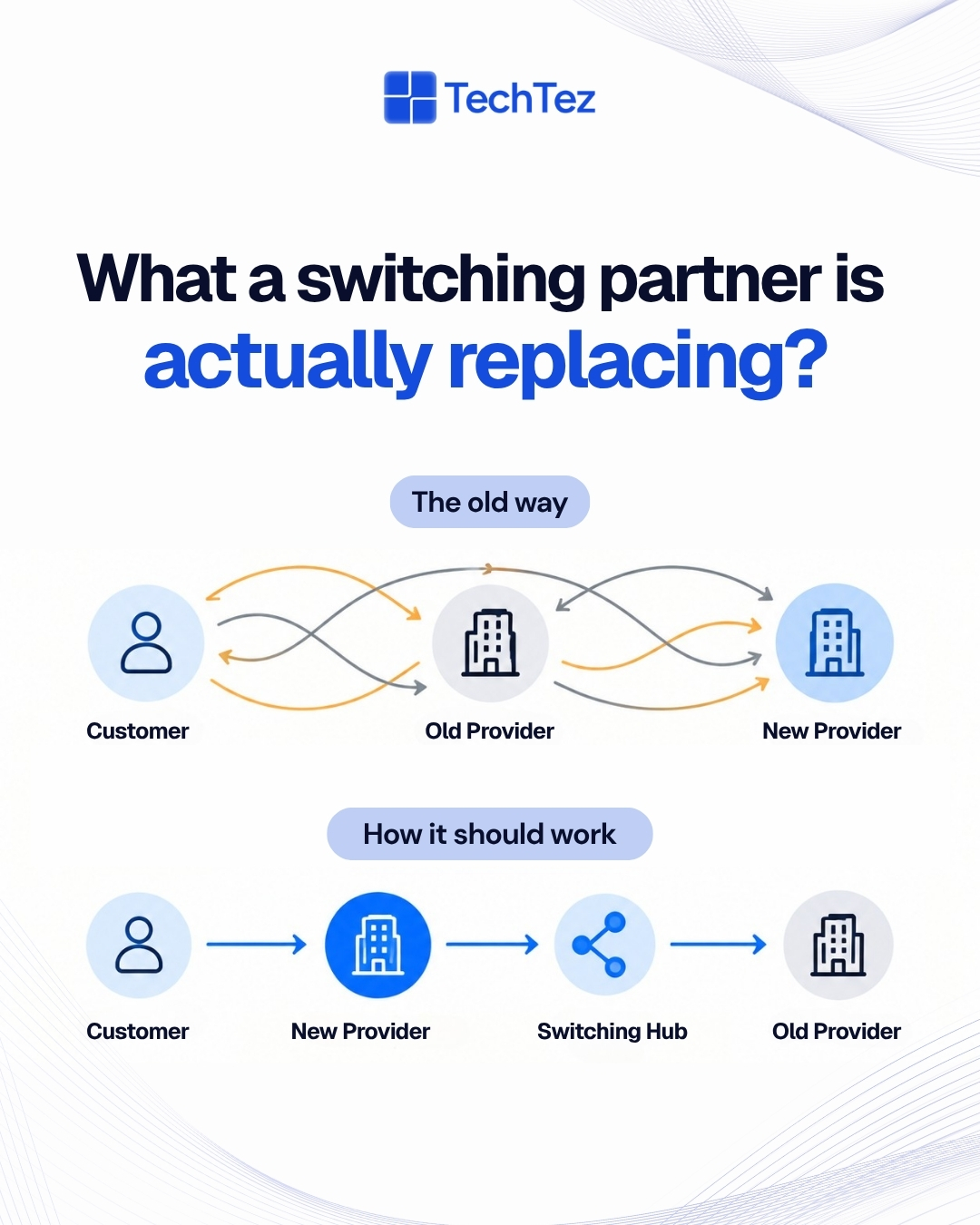
Getting connected to the TOTSCo Hub is a one-time technical project: build the integration, run it through TOTSCo’s test environment, pass certification, go live. Most partners clear that bar, and most will lead with it in a pitch. But a Hub connection only proves a partner could switch messages correctly on the day they were certified, and it says nothing about whether they still can.
That gap matters because the Hub isn’t a fixed target. TOTSCo updates its message specifications as new edge cases surface, as match-rate problems get found, and as business switching gets layered on top of the residential system. Each update can change field formats, timing rules, or how a failure gets reported back. A partner who integrated once in, say, 2024 and never touched that integration again is running against a spec that’s already out of date, which shows up as silent match failures, stalled switches, or errors that get blamed on “the Hub” when the real cause is a partner who stopped maintaining their side of it. So the real test isn’t “are you connected,” it’s “how do you know when the ground has moved, and what do you do about it”.
How Partners actually stay Compliant Day to Day
Certification is a snapshot, not a guarantee. The two things that actually separate a compliant partner from a merely connected one both happen after go-live: whether they keep pace with TOTSCo’s spec changes instead of waiting to find out the hard way, and whether they’ve committed to a routing model for business switching rather than defaulting to whatever they built first. Neither shows up in a pitch deck. Both show up in production, usually during your busiest switching period, when a stalled case or a misrouted message becomes a customer complaint instead of a line item on a partner’s roadmap. Ask about both before you sign.
Testing Cadence and Spec-Change Discipline
Ask a partner directly: when did they last update their Hub integration against a spec change, and how did they find out it had happened? A partner with a real answer will describe a monitoring process, subscription to TOTSCo bulletins, a dedicated integration owner, a regression suite that runs against every spec revision. A partner without one will describe finding out “when something broke,” which means the next spec change becomes your production incident, not theirs.
This matters more than it sounds. Ofcom’s own enforcement history shows the industry has already missed one major deadline collectively, the original April 2023 target slipped seventeen months because the Hub itself wasn’t production-ready. A partner who treats spec compliance as a one-time integration project rather than an ongoing discipline is repeating that same mistake at the vendor level, on your account, on your timeline. Ask for evidence, not reassurance: a changelog, a testing calendar, or a named point of contact for spec updates tells you more than any claim of “we’re always up to date.”
Choosing between Hub-Only and MESH/CSF Routing
Business switching under GPLB doesn’t require routing through TOTSCo’s Hub specifically, there’s no mandate to use any particular solution, and the industry explicitly treats business switching as a competitive market. Some partners route everything centrally through the Hub. Others support the decentralized MESH/CSF exchange the GPLB steering group built as an alternative.
Neither approach is inherently superior, the right choice depends on how many losing providers you regularly interact with and whether those providers have standardized on one model. A partner locked into Hub-only routing may struggle if a key counterpart provider has gone MESH-first, and vice versa. Ask which model the partner supports today, whether they support both, and what their plan is if the industry consolidates toward one over the other. A partner with no opinion on this hasn’t thought past their own current build, and betting your account on whichever model they happened to ship first is a bet you’re making, not them. Our comparison of TOTSCo Hub vs. MESH/CSF walks through the trade-offs in detail.
Test whether “Cancel Other” is actually gone
This is the fastest disqualifier available to you. Ofcom found the “Cancel Other” mechanism had no basis in its General Conditions and eliminated it. Any partner still running a relabelled version internally, even as a “retention safeguard,” is not compliant under C7.18 to C7.27, regardless of internal naming.
The mechanism let a losing provider unilaterally cancel a customer’s switch request, often without clear consent, framed internally as “saving” the account. It worked because it was invisible: customers believed they’d initiated a clean switch while the process was quietly intercepted and closed out behind them. Ofcom’s ruling didn’t just discourage this, it removed any regulatory basis for it to exist, so there’s no compliant version left to build under any name.
That’s where the risk hides now. No partner markets a “Cancel Other” feature post-ruling, but the same behaviour survives as a “save flow,” a “retention step,” or a “confirmation override” only the losing side can trigger. Don’t take a sales deck’s word for it. Ask to see the actual cancellation flow end to end and confirm no point lets the losing side unilaterally halt or reroute a switch without the customer’s explicit action.
Watch the answer as closely as the flow. A partner who hedges, or describes a “special case” where the old override still applies, should be removed from consideration immediately, no exceptions, no further diligence needed.
Switching-Out Deserves the Same Scrutiny as Switching-in
Most partners demo switching-in in detail, it’s the flow that wins the sale. Fewer show switching-out with equal rigor, and that asymmetry is exactly what caught Virgin Media.
- Sales demos sell, they don’t prove compliance: Switching-in is polished and rehearsed. It says nothing about how a partner behaves once a customer tries to leave.
- Ofcom judged experience, not infrastructure: The ruling didn’t turn on Hub connectivity. It turned on what actually happened to a real customer trying to cancel.
- Largest consumer protection fine of its kind: Issued against a provider that was nominally compliant on paper, while cancellation was deliberately difficult in practice.
- A description isn’t the flow: Slide decks and process diagrams can describe a journey that doesn’t match reality. Demand to see it live, end to end.
- Reluctance is the answer: If a partner hesitates to show switching-out with the same detail as switching-in, walk away.
Check how partners handle the Cases OTS didn’t fully anticipate
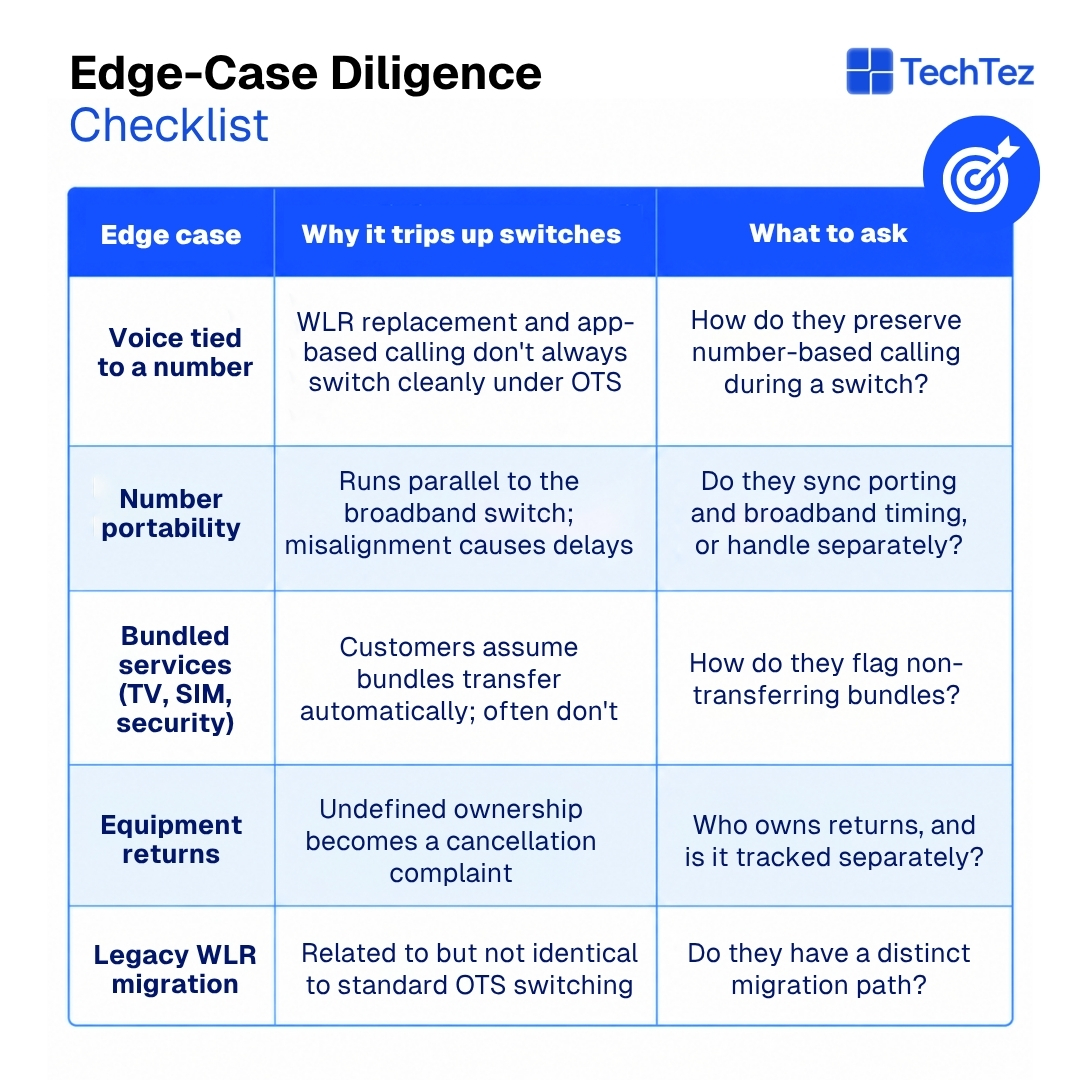
OTS covers a standard broadband-and-landline switch cleanly. It’s the adjacent cases, voice services tied to a number, number portability running in parallel, bundled add-ons, equipment logistics, where partner maturity actually shows. A partner who’s only handled the textbook case discovers these gaps in production, on your account, with your customers watching. A partner who’s already built specific handling for each edge case has clearly been through this before. Use the table below as a quick reference during vendor calls, and push for a specific answer to each row rather than a general assurance that “edge cases are handled.”
Voice, Portability, and Bundled Services
Voice is the trickiest case, because OTS predates the complexity IP voice services introduced. Features tied to a phone number, like WLR replacements or router-based calling, don’t always switch cleanly as written. A good partner can describe specifically how they detect and handle it, rather than treating every voice-adjacent switch as standard.
Number portability runs as a parallel process to the broadband switch, and misalignment between the two is a common source of delay, a number stranded mid-port while broadband completes, or the reverse. Bundled services add another layer of confusion: customers assume TV, SIM, or security add-ons transfer automatically, and when they don’t, it reads as a broken switch. A partner should flag non-transferring bundles before the switch starts, and be able to show exactly where that flag appears in their process.
Equipment Returns and Legacy WLR Migration
Ownership of equipment returns is often left undefined. OTS gives the gaining provider the switch itself, not responsibility for the losing provider’s kit, and that gap becomes exactly the kind of friction Ofcom penalised Virgin Media for. Ask directly who owns this workflow, whether it’s tracked as a distinct step, and how failures get surfaced.
Legacy WLR migration is a narrower but real gap for CPs still running that infrastructure. It overlaps with standard OTS switching without being identical to it. One question tells you more than almost anything else on this list: do they have a separate migration path for WLR, or do they fold it into standard OTS handling? A vague answer usually means they haven’t hit this case at scale yet.
Weigh Timeline Discipline, GPLB Readiness, and Audit Trails
The industry missed its original April 2023 deadline by seventeen months, and the Hub didn’t reach production readiness until September 2024, not from laziness, but because the work was genuinely hard at scale. Timeline claims deserve scrutiny, not optimism.
- Ask for a dated implementation plan, not a range.
- Ask what happened the last time they missed a deadline. A partner who’s never missed one hasn’t been tested; one who has and can explain what changed after is more trustworthy than either.
Business switching sits roughly where residential OTS sat in 2022: industry-built, with no Ofcom mandate yet, read as “not mandatory yet,” not optional. TOTSCo opened business switching onboarding in July 2025, and the CSF spec has matured fast without regulatory pressure. A partner with no GPLB roadmap today will leave you scrambling later, the way residential CPs scrambled in 2023, except this time you’ve had eighteen months of visible warning. See our Business vs. Residential switching comparison for how the tracks diverge.
Demand an Audit Trail, Not a Promise
Ofcom expects retained Hub message records and switch outcomes, available on request. A partner who can’t produce this on demand is asking you to take compliance on faith.
- Retained, searchable audit trails by switch and by customer.
- A defined retention period.
- A defined export format.
Build all three into the contract explicitly, rather than assuming they exist because the partner says so.
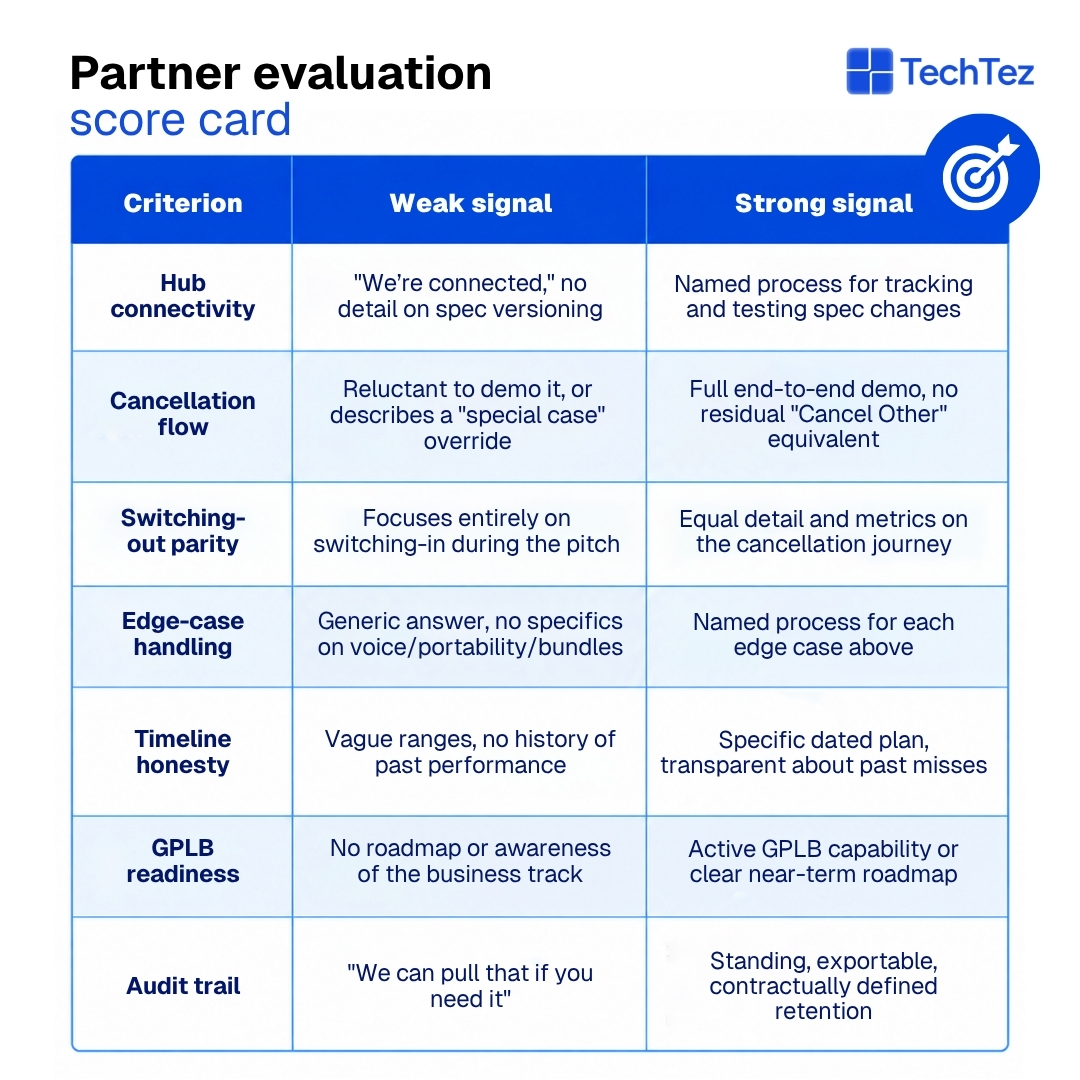
Partner Evaluation Scorecard
Every criterion in this framework collapses into one working sheet. Run it during vendor conversations, not as a one-time box-ticking exercise, score each row live as a partner answers, and revisit it as you move from first call to contract.
Choosing the Right Switching Partner
Choosing a switching partner requires looking beyond technical connectivity. A Hub connection confirms that a partner can participate in the switching ecosystem, but it does not demonstrate how effectively they handle real customer journeys. Providers should evaluate cancellation flows, switching-out, specification changes, edge cases, GPLB readiness, and auditability. The strongest partners can demonstrate these capabilities through clear processes, testing practices, documented timelines, and evidence from production. This approach helps distinguish a partner that is simply connected from one that can consistently support compliant and reliable switching.
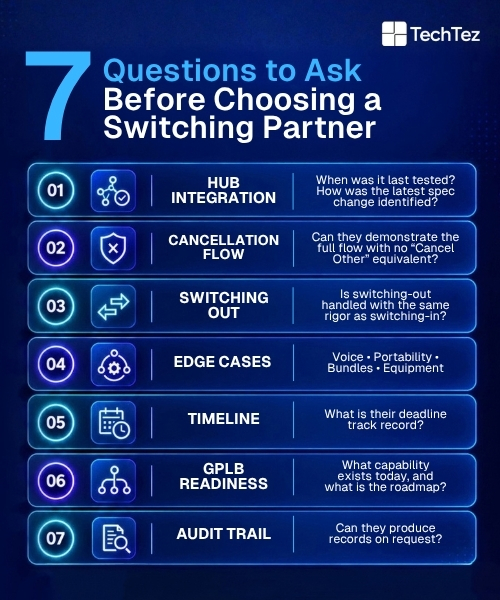
The Seven-Question Checklist
A partner who answers all seven with specifics has actually run this gauntlet before. One who answers with reassurance instead of specifics is one you’ll be auditing again after the next enforcement headline.
Look Beyond Hub Connectivity
The real test of a switching partner is how they perform when switching becomes complex. Ask when their Hub integration was last tested, how they track specification changes, and how quickly they respond to new requirements. Examine the complete cancellation and switching-out journey to ensure there are no hidden mechanisms that can interfere with a customer’s decision to switch.
Edge-case handling should receive equal attention. Partners should have clear processes for voice services, number portability, bundled products, equipment returns, and legacy WLR migration. Business switching also makes GPLB capability and roadmap an important consideration.
Finally, ask for evidence rather than assurances. A dependable partner should provide clear audit trails, defined ownership, testing records, and transparent timelines. Hub connectivity is the starting point; operational maturity is what makes a switching partner dependable.