
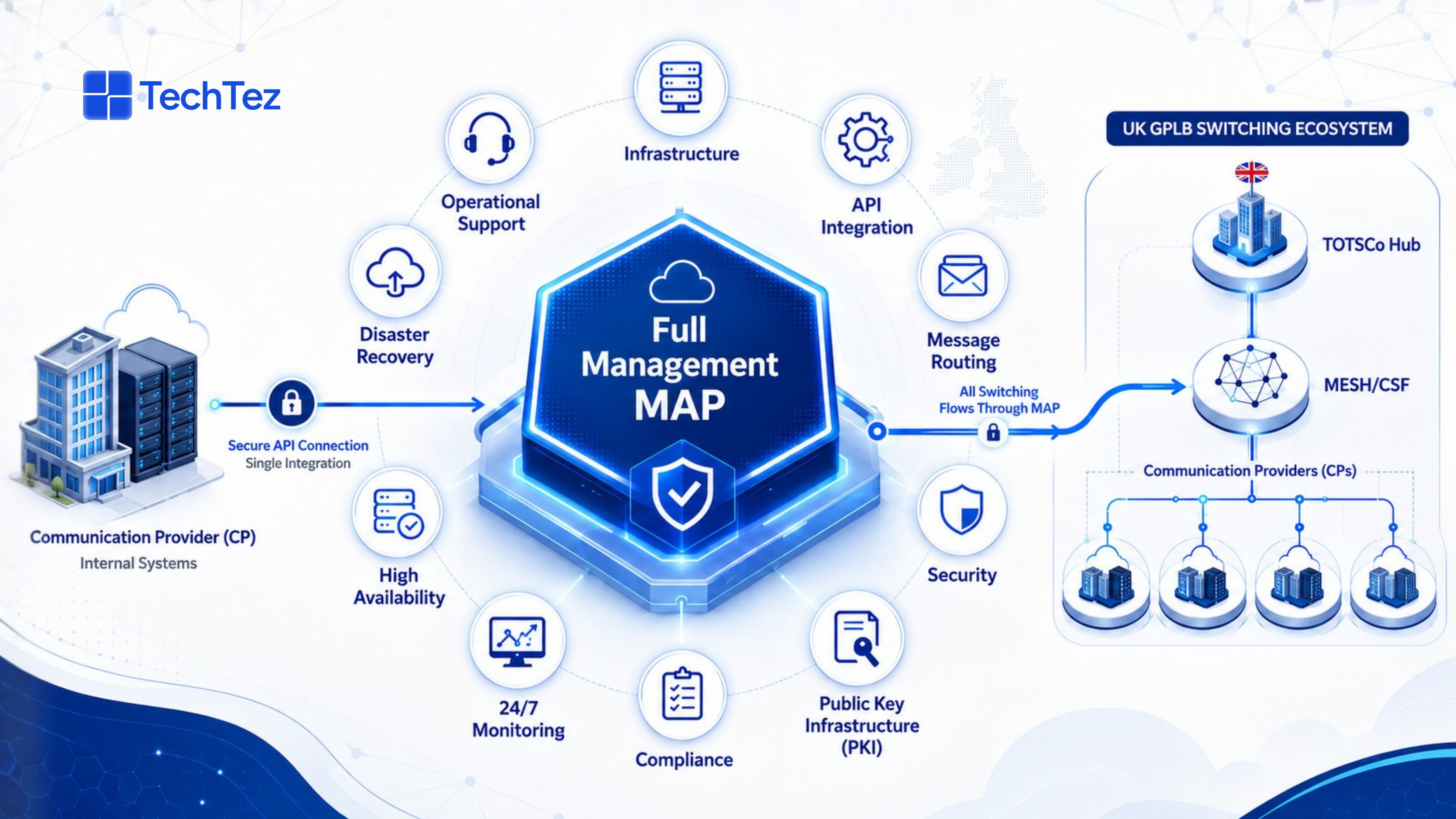

A Full Management Managed Access Provider (MAP) is a technical partner that runs the entire GPLB switching platform on a Communication Provider’s behalf, covering infrastructure, PKI and security, API integration, compliance updates, and 24/7 monitoring. Unlike a standard MAP, which mainly provides connectivity, a Full Management MAP takes full operational ownership, so the CP’s own engineering team doesn’t have to.
That distinction matters more than it sounds. As the UK telecom industry moves to Gaining Provider Led Business (GPLB) switching, every Communication Provider hits the same fork: build and run the switching infrastructure themselves, or hand that operational load to a partner. The choice affects implementation timelines, ongoing costs, who owns compliance risk, and how easily the platform scales as switching volume grows.
Unlike a standard MAP that primarily provides connectivity, a Full Management MAP takes responsibility for the entire switching ecosystem on your behalf. From infrastructure and API management to security, compliance, monitoring, and ongoing operational support, it enables Communication Providers to participate in GPLB without managing the technical complexities themselves. The difference is more than just a service offering. It influences implementation timelines, operational costs, compliance responsibilities, platform resilience, and your ability to scale as business switching evolves.
In this guide, we’ll explain what a Full Management MAP means, how it differs from a standard MAP, the responsibilities it takes on, and why many UK Communication Providers are choosing a fully managed approach to simplify GPLB switching.
What is a Managed Access Provider (MAP)?
A Managed Access Provider (MAP) lets a Communication Provider participate in GPLB switching without building and maintaining its own switching infrastructure. Under GPLB, CPs exchange switching messages securely with other providers while meeting industry standards for interoperability and compliance. Depending on the chosen architecture, a MAP can connect Communication Providers through the TOTSCo Hub or support direct message exchange using the MESH/Connected Services Framework (CSF). In either model, the MAP is responsible for ensuring that switching messages are exchanged securely, accurately, and in accordance with industry specifications.
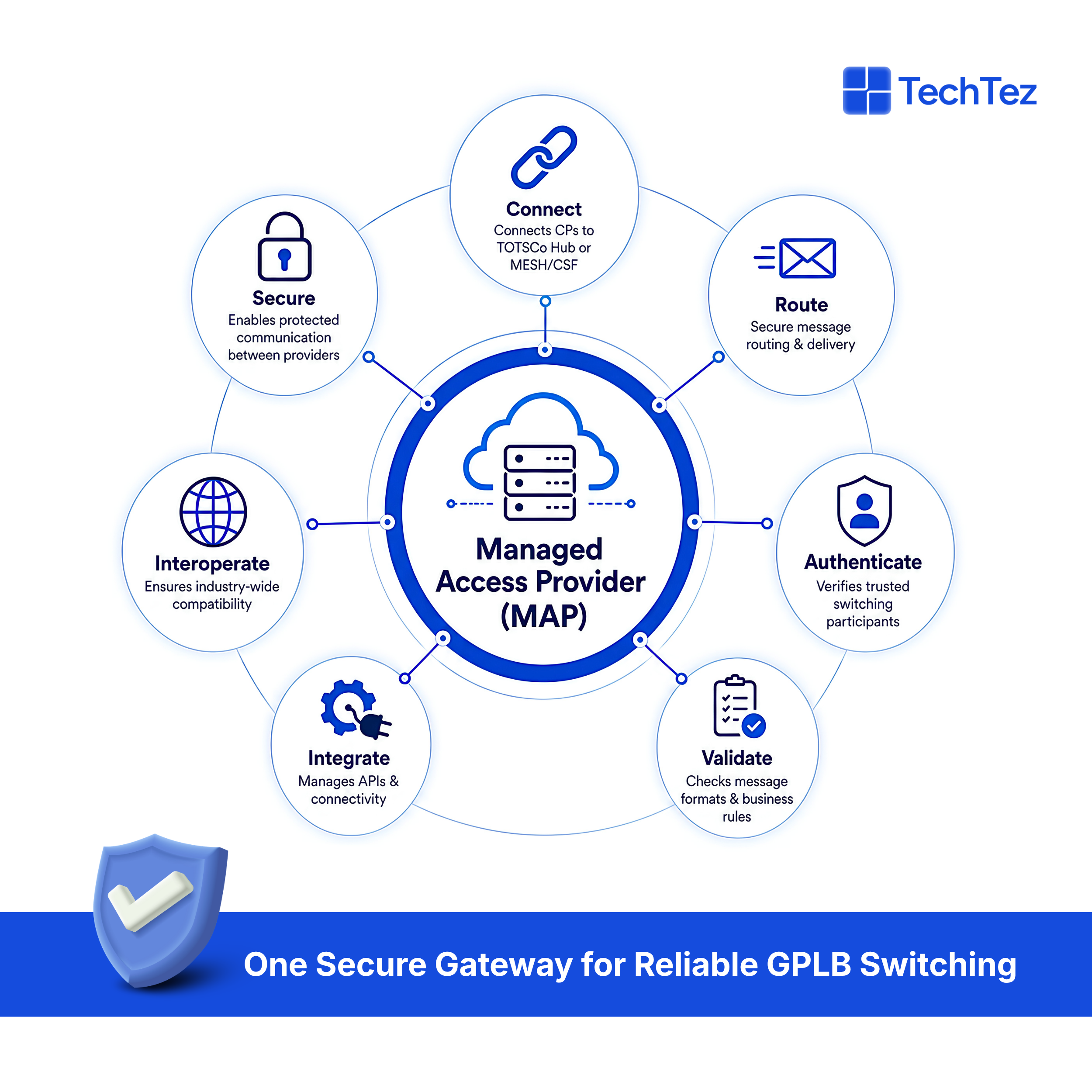
In simple terms, a MAP acts as the bridge between a Communication Provider and the wider GPLB switching ecosystem, allowing providers to focus on delivering services while the technical exchange of switching messages happens reliably behind the scenes. Not every MAP offers the same depth of service, though. Some provide only the technical connection, leaving the CP responsible for infrastructure, security, monitoring, and compliance. Others go further and take on the entire operational lifecycle. That second category is Full Management.
What Full Management actually Adds
A Full Management Managed Access Provider (MAP) goes far beyond simply connecting a Communication Provider (CP) to the UK’s GPLB switching ecosystem. Instead of acting as a gateway for switching messages, it takes responsibility for the entire operational lifecycle of business switching on behalf of the Communication Provider.
In a standard MAP model, the provider is often responsible for managing much of the underlying infrastructure, security, monitoring, compliance, and ongoing maintenance. A Full Management MAP removes that burden by delivering a fully managed service that keeps the switching platform secure, compliant, resilient, and operational around the clock. This means the MAP doesn’t just provide an API endpoint it manages everything required to ensure switching services run smoothly. From hosting and maintaining the infrastructure to managing security, monitoring performance, handling compliance updates, and supporting day-to-day operations, the Full management MAP becomes an extension of the Communication Provider’s technical team.
Instead of investing time and resources into building specialist expertise in APIs, Public Key Infrastructure (PKI), security, message routing, resilience, and compliance, Communication Providers can rely on a Full Management MAP to handle these responsibilities on their behalf. The result is a simpler operational model:
- Communication Providers focus on delivering services, supporting customers, and growing their business.
- The Full Management MAP manages the infrastructure, security, interoperability, compliance, monitoring, and operational processes that keep business switching running reliably behind the scenes.
In short, a Full Management MAP transforms business switching from a complex technical project into a fully managed operational service, enabling Communication Providers to achieve GPLB readiness faster while reducing operational risk and long-term maintenance overhead.
What Does a Full Management MAP Handle?
A Full Management MAP’s scope goes well beyond a technical connection. It’s an end-to-end managed service that treats switching as an ongoing operational responsibility, not a one-time integration. Infrastructure must stay available, security controls must stay current, APIs must track specification changes, and issues must get caught before they reach a customer. Five areas make up the bulk of that responsibility.
Infrastructure Management
A reliable switching platform begins with a resilient infrastructure. Every switching request depends on systems that are secure, available, and capable of processing transactions without interruption. A Full Management MAP designs, hosts, and manages this infrastructure, ensuring Communication Providers don’t have to invest in dedicated hosting environments or specialist operations teams.
Infrastructure management isn’t limited to maintaining servers. It involves proactively managing the entire platform lifecycle so that the environment remains performant, scalable, and available even as switching volumes grow. A Full Management MAP typically manages:
- High Availability (HA): Ensures switching services remain available with minimal downtime.
- Disaster Recovery (DR): Implements backup and recovery strategies to maintain business continuity.
- Performance Optimisation: Continuously tunes infrastructure for faster message processing and reduced latency.
- Capacity Planning: Scales infrastructure to support future growth and increased transaction volumes.
- Infrastructure Monitoring: Tracks server health, application performance, and resource utilisation in real time.
- Routine Maintenance: Applies updates, patches, and platform enhancements without disrupting services.
- Scalability Planning: Ensures the platform can accommodate new Communication Providers and increasing workloads.
The result is a CP with access to an enterprise-grade platform it never has to build, staff, or maintain itself.
Security & PKI Management
Security is one of the most critical pillars of GPLB switching. Every switching request must be authenticated, encrypted, and verified to ensure messages are exchanged securely between trusted participants. A Full Management MAP manages this entire security framework, allowing Communication Providers to meet industry requirements without becoming specialists in cryptography or certificate management.
This includes maintaining the complete Public Key Infrastructure (PKI) ecosystem that underpins secure communications and ensuring all security processes remain compliant with evolving industry standards. A Full Management MAP is responsible for:
- Public Key Infrastructure (PKI): Managing the trust framework used for secure communications.
- Certificate Lifecycle Management: Issuing, renewing, revoking, and maintaining digital certificates.
- Digital Signatures: Verifying message authenticity and integrity.
- Encryption: Protecting sensitive switching data during transmission.
- Secure Authentication: Ensuring only authorised participants exchange messages.
- Certificate & Key Rotation: Regularly updating cryptographic keys to maintain security.
- Security Monitoring: Detecting and responding to potential threats or vulnerabilities.
- Security Updates & Patch Management: Keeping systems protected against emerging risks.
Rather than building in-house expertise around PKI and security operations, Communication Providers can rely on the MAP’s dedicated security specialists to maintain a secure, compliant, and resilient switching environment.
API Integration & Message Routing
At the core, GPLB switching is the seamless exchange of messages between Communication Providers (CPs). Every switching request must be formatted correctly, validated against industry specifications, securely transmitted, and delivered to the intended recipient without delays or errors. Managing these integrations internally can become increasingly complex, particularly as the number of switching partners and technical requirements grows.
A Full Management MAP simplifies this process by acting as the central integration layer between the Communication Provider and the wider switching ecosystem. Rather than maintaining multiple integrations with different participants, the CP integrates with a single managed platform that handles message validation, routing, interoperability, and delivery. This ensures switching transactions are processed efficiently while remaining compliant with GPLB technical standards. A Full Management MAP typically manages:
- API Connectivity: Provides secure, standardised APIs for seamless integration with the Communication Provider’s systems.
- Message Validation: Verifies that every switching message complies with the required data structure and business rules before processing.
- Schema Compliance: Ensures all messages conform to the latest GPLB and industry-defined schemas.
- Intelligent Routing: Routes switching requests securely through the appropriate architecture, whether via the TOTSCo Hub or MESH/Connected Services Framework (CSF).
- Retry & Recovery Mechanisms: Automatically retries failed transactions and manages temporary communication issues without manual intervention.
- Delivery Tracking: Monitors message delivery status and confirms successful transmission between participants.
- Error Handling & Logging: Captures, logs, and reports processing errors to enable faster diagnosis and resolution.
By managing the entire message lifecycle, a Full Management MAP reduces integration complexity, improves interoperability, and enables Communication Providers to participate in GPLB switching without maintaining multiple external connections or specialist messaging infrastructure.
Compliance Management
Achieving GPLB compliance isn’t a one-time milestone, it’s an ongoing responsibility. As industry standards, technical specifications, and regulatory requirements continue to evolve, Communication Providers must ensure their switching platforms remain aligned with the latest changes. Failing to keep pace with these updates can lead to interoperability issues, operational disruptions, or increased compliance risk.
A Full Management MAP continuously monitors the regulatory and technical landscape, implementing necessary updates on behalf of the Communication Provider. This proactive approach ensures that switching services remain compliant without requiring internal engineering teams to track every specification change or manage frequent platform updates themselves. A Full Management MAP supports compliance by managing:
- Industry Specification Updates: Implements changes to GPLB and business switching standards as they are released.
- API Version Management: Maintains compatibility with evolving API specifications and coordinates version upgrades.
- Security Compliance: Ensures encryption, authentication, and certificate management remain aligned with current security requirements.
- Regulatory Changes: Adapts systems and processes to reflect new regulatory obligations and operational guidance.
- Operational Readiness: Performs testing and validation before deploying updates to minimise disruption.
- Interoperability Assurance: Confirms continued compatibility with other Communication Providers and Managed Access Providers.
- Documentation & Audit Support: Maintains operational records and technical documentation to support governance and audit requirements.
With a Full Management MAP overseeing compliance, Communication Providers can focus on their core business while remaining confident that their switching platform continues to meet industry expectations and evolving GPLB requirements.
Monitoring & Support
Business switching is a mission-critical service that operates continuously, making proactive monitoring and responsive operational support essential. Even minor issues can affect message delivery, delay switching requests, or impact the customer experience if they are not detected and resolved quickly. A Full Management MAP provides dedicated operational oversight to ensure the switching platform remains secure, available, and performing at its best around the clock.
Rather than waiting for problems to occur, the MAP continuously monitors the health of the platform, identifies potential risks, and resolves issues before they affect business operations. This proactive approach helps maximise service availability while providing Communication Providers with greater confidence in the reliability of their switching environment. A Full Management MAP typically provides:
- 24/7 Platform Monitoring: Continuously monitors infrastructure, APIs, and message processing to ensure uninterrupted service.
- Incident Management: Rapidly investigates and resolves operational issues to minimise disruption.
- Performance Dashboards: Provides visibility into system health, message volumes, and operational performance.
- Real-Time Alerting: Detects anomalies and automatically notifies support teams of potential issues.
- Troubleshooting & Root Cause Analysis: Identifies the underlying cause of incidents to prevent recurrence.
- Operational Reporting: Delivers regular reports on platform performance, availability, and service metrics.
- Preventative Maintenance: Performs routine health checks, updates, and optimisation to maintain long-term platform stability.
By combining continuous monitoring with dedicated operational support, a Full Management MAP helps ensure GPLB switching services remain reliable, secure, and resilient. This allows Communication Providers to concentrate on serving their customers while experienced specialists manage the day-to-day operation of the switching platform.
Full Management MAP vs Standard MAP
While both Standard Managed Access Providers (MAPs) and Full Management MAPs enable Communication Providers (CPs) to participate in the UK GPLB switching ecosystem, the level of service they provide is fundamentally different. Both models facilitate the secure exchange of switching messages and support interoperability with other participants. However, the responsibilities assigned to the Communication Provider vary significantly.
A Standard MAP primarily focuses on providing the technical connectivity required to access the switching ecosystem. The Communication Provider remains responsible for managing much of the underlying infrastructure, security, compliance, monitoring, and ongoing operational maintenance.
A Full Management MAP, on the other hand, extends far beyond connectivity. It delivers a fully managed operational service, taking ownership of the technology, platform management, security, compliance, and day-to-day support needed to keep switching services running efficiently.
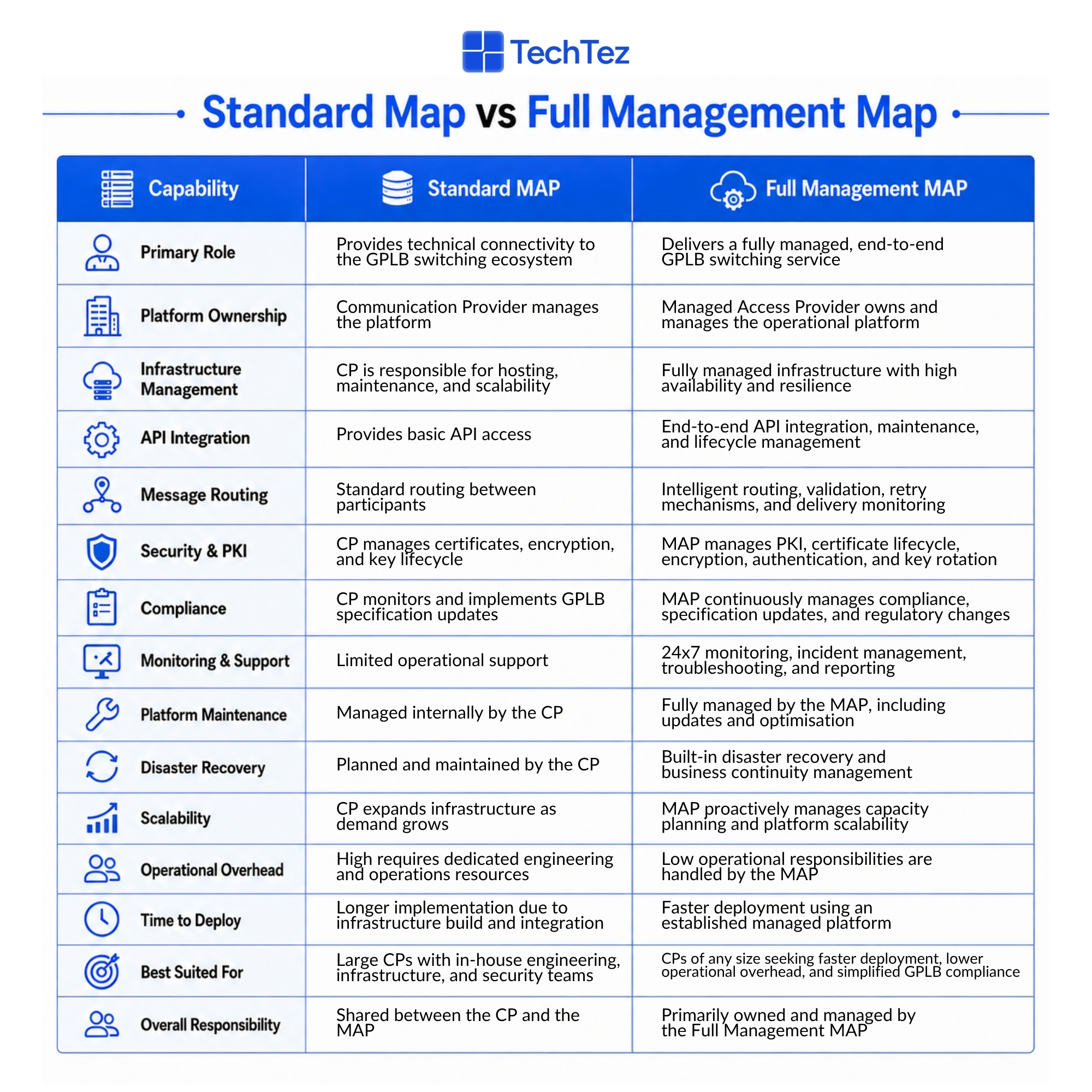
The key difference ultimately comes down to ownership.
A Standard MAP provides the technical access needed to participate in GPLB switching, leaving the Communication Provider responsible for operating and maintaining the platform.
A Full Management MAP takes ownership of the operational environment itself, managing the infrastructure, security, compliance, monitoring, and ongoing platform operations. This enables Communication Providers to focus on delivering services and supporting customers while relying on a specialist partner to manage the complexities of business switching.
Why Communication Providers Choose Full Management MAP
As GPLB implementation deadlines approach, many CPs are discovering that building an internal switching platform requires far more resources than initially expected. A Full Management MAP reduces that burden.
The primary benefits include:
- Faster Time to Market: Rather than building infrastructure from scratch, providers can onboard significantly faster using an existing managed platform.
- Lower Operational Overhead: Internal engineering teams remain focused on customer-facing products instead of maintaining switching infrastructure.
- Reduced Compliance Risk: Industry standards continue to evolve. A Full Management MAP ensures systems remain aligned with changing technical specifications.
- Improved Reliability: Enterprise-grade infrastructure, monitoring, redundancy, and operational processes reduce service interruptions.
- Predictable Costs: Instead of ongoing investments in infrastructure, security, monitoring, and specialist staff, providers typically operate under a predictable managed service model.
When Does Full Management Make the Most Sense?
Full Management MAP services are particularly valuable for:
- Small and medium-sized Communication Providers
- ISPs entering GPLB for the first time
- Organisations without dedicated platform engineering teams
- Providers seeking rapid compliance
- Businesses looking to minimise operational complexity
- CPs wanting to outsource security and infrastructure management
Large providers may also choose Full Management where operational efficiency outweighs the benefits of running their own switching platform.
Common Misconceptions About Full Management MAP
- “We’ll lose control.”: Not necessarily. Communication Providers retain ownership of their business processes, customer relationships, and commercial decisions. The MAP simply manages the technical switching infrastructure.
- “It’s only for smaller providers.”: Many larger organisations also use managed platforms to reduce operational costs and accelerate implementation. The decision is often commercial rather than technical.
- “Full Management means less security.”: Quite the opposite. Most Full Management MAPs employ specialist security teams dedicated to certificate management, infrastructure hardening, monitoring, and compliance. For many providers, this delivers stronger operational security than managing everything internally.
How to Choose the Right Full Management MAP
Not every managed service offers the same capabilities. When evaluating potential MAP partners, consider:
- GPLB implementation experience
- TOTSCo integration expertise
- Support for MESH/CSF where applicable
- Security certifications
- PKI management capabilities
- Service Level Agreements (SLAs)
- High availability architecture
- Disaster recovery planning
- Monitoring and reporting
- Future scalability
Choosing a MAP should be viewed as a long-term operational partnership rather than simply selecting another technology supplier.
Why Full Management Matters: Final Thoughts
GPLB introduces new opportunities for Communication Providers, but it also introduces new operational responsibilities. Building secure switching infrastructure requires expertise across networking, APIs, PKI, compliance, monitoring, and resilience.
A Full Management Managed Access Provider is far more than a message-routing service. It delivers an end-to-end operational platform that enables Communication Providers to participate confidently in GPLB switching without taking on the complexity of infrastructure management, security, compliance, and ongoing operations. Instead of investing months building and maintaining specialised infrastructure, CPs can focus on delivering customer value while relying on experienced switching specialists to manage the technical ecosystem. For many providers, that’s the difference between simply becoming compliant and building a sustainable switching operation.
Whether you’re a Communication Provider beginning your GPLB journey or a Managed Access Provider evaluating service models, understanding what Full Management truly means is the first step towards making the right architectural decision.