
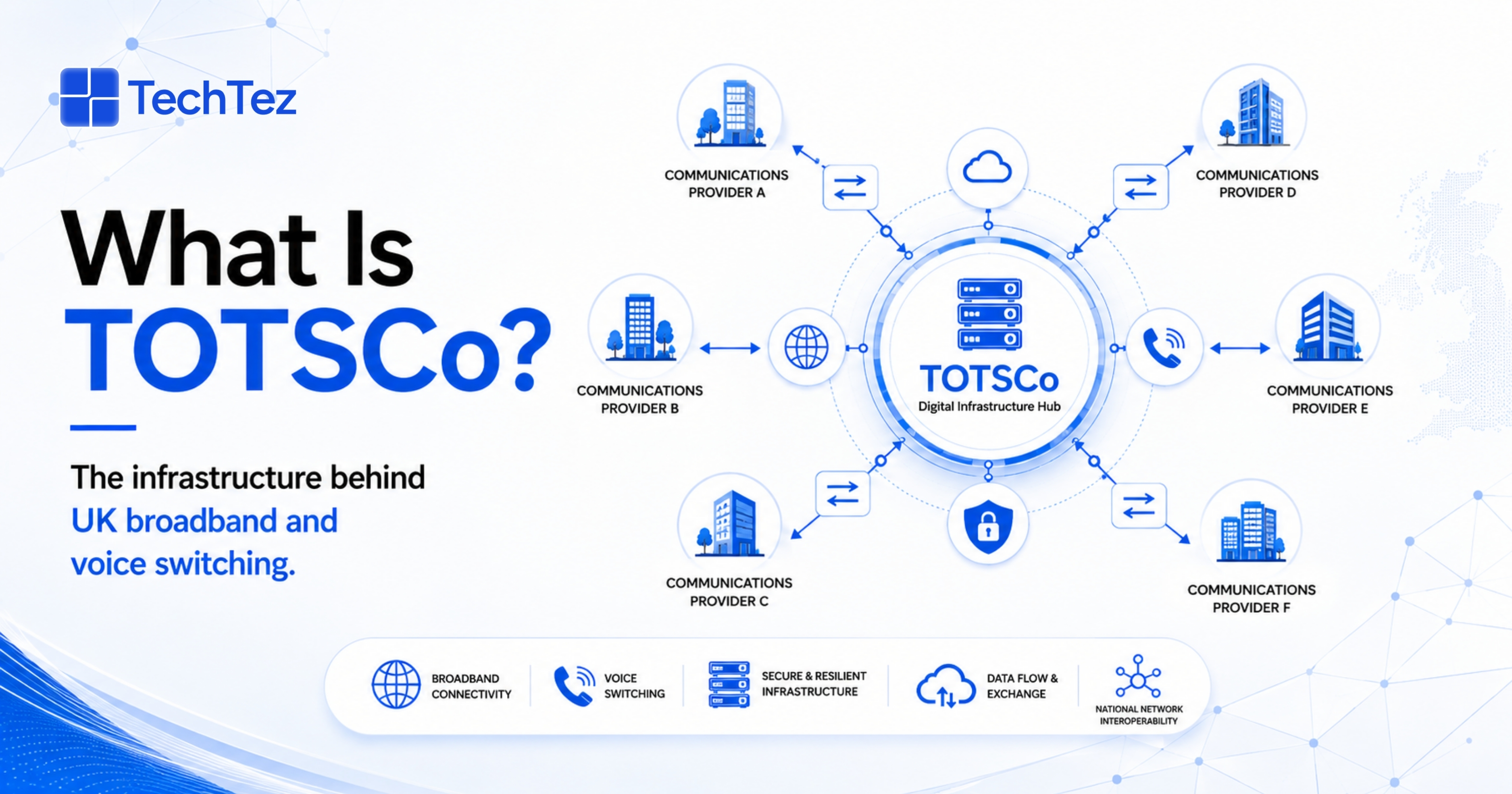

TOTSCo (The One Touch Switching Company) is the UK telecom industry’s not-for-profit organisation that operates the TOTSCo Hub, a secure messaging platform supporting One Touch Switch. It lets Communications Providers exchange standardised switching messages for fixed broadband and voice services and is now extending into Gaining Provider Led Business (GPLB) switching for more complex business migrations.
TOTSCo provides the shared infrastructure that lets gaining and losing providers exchange the information needed to identify customers, coordinate switches, and keep the process moving making it especially relevant for smaller and mid-sized CPs deciding whether to build a direct Hub connection or work with a Managed Access Provider (MAP).
What Is TOTSCo and Why Was It Created?
TOTSCo was established by the UK telecoms industry in June 2022, after Ofcom decided to simplify switching for fixed broadband and voice customers. It’s structured as a not-for-profit, member-owned organisation rather than a network operator or regulator.
Its core job is operating the Hub and working with the industry to improve switching over time. Membership is open to qualifying providers, but a CP doesn’t need to join to use the Hub as the official. TOTSCo , the organization provides the trusted infrastructure that works behind the scenes to enable secure, standardized switching between Communications Providers across the UK.
Is TOTSCo the Same as Ofcom?
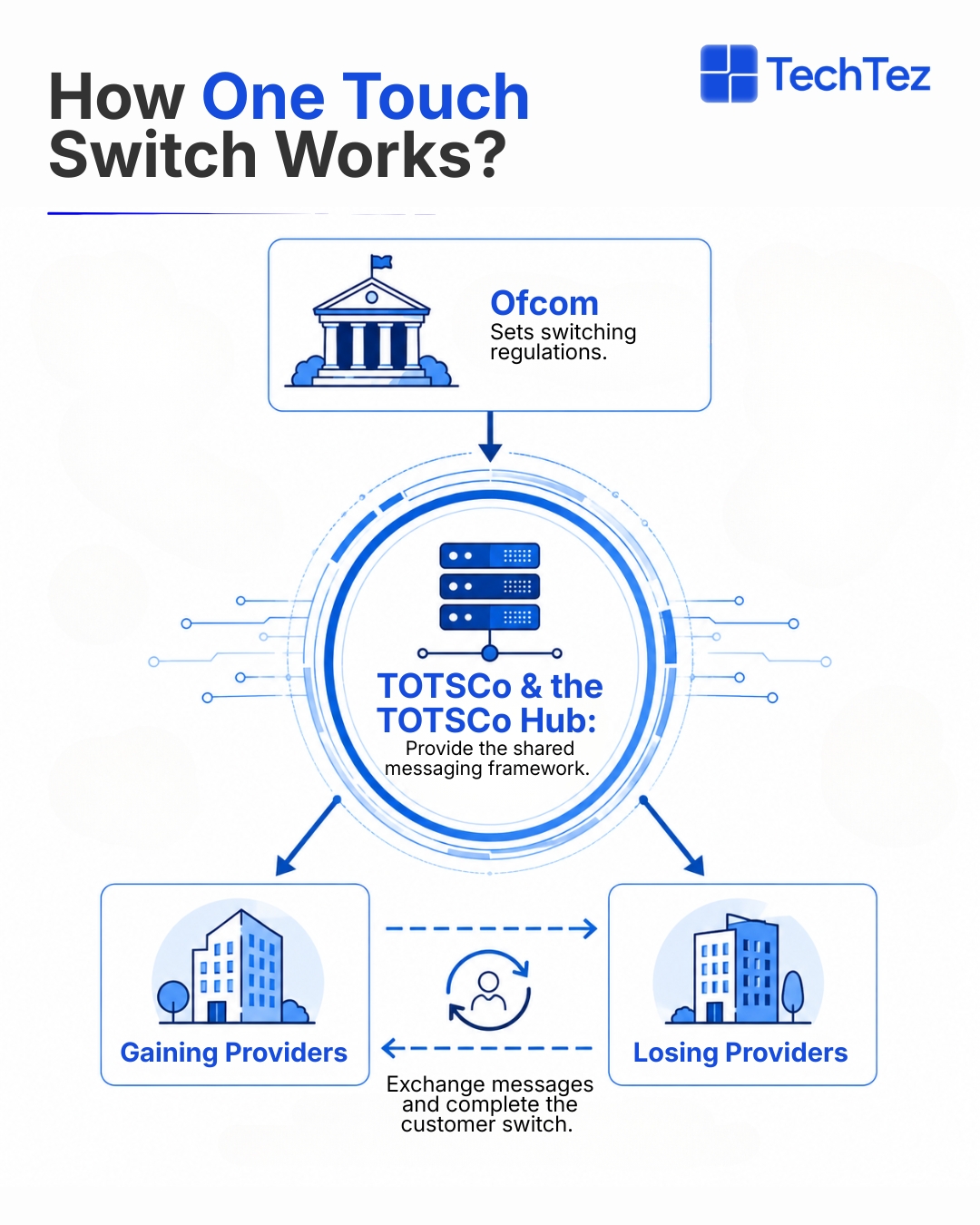
No. Ofcom and TOTSCo have distinct roles within the UK telecom ecosystem. Ofcom is the UK’s communications regulator responsible for setting and enforcing the rules that govern broadband, voice, and switching services. These requirements are outlined in the govern broadband, voice, and switching services. These requirements are outlined in the General Conditions of Entitlement, including General Condition C7, which covers switching processes, service continuity, customer information, number porting, and associated timelines.
TOTSCo, on the other hand, is an industry-owned, not-for-profit organization. It does not create or enforce regulations. Instead, it operates the TOTSCo Hub, the secure messaging infrastructure that enables Communications Providers (CPs) to exchange standardized switching information and comply with Ofcom’s requirements. Simply put, Ofcom sets the rules, while TOTSCo provides the infrastructure that helps Communications Providers implement them. Providers remain responsible for understanding and meeting their regulatory obligations throughout the switching process.
What Does the TOTSCo Hub Do?
The TOTSCo Hub is a secure messaging platform that enables Communications Providers (CPs) to exchange standardized switching information for broadband and voice services. It doesn’t move customer connections or port numbers directly instead; it facilitates the structured communication needed to coordinate the switching process between gaining and losing providers.
Through the Hub, providers can:
- Identify and match customer or service information.
- Confirm matches and communicate any switching implications.
- Place, update, trigger, or cancel switch orders.
- Report processing errors or failed transactions.
By providing a single, standardized exchange point, the TOTSCo Hub eliminates the need for individual integrations between every Communications Provider. This simplifies connectivity, improves interoperability, reduces operational complexity, and supports a more efficient and reliable switching experience across the UK telecom industry.
How One Touch Switch Works
The industry wide One Touch Switch service successfully launched for most customers on 12 September 2024. TOTSCo reported that 167 brands were present in the live directory at launch. By 2026, the organization had passed 3 million completed switches, demonstrating the scale at which the Hub now operates, with the official TOTSCo Residential Switching providing detailed guidance on the switching journey, message flows, onboarding requirements, and technical implementation for Communications Providers.
The industry wide One Touch Switch service successfully launched for most customers on 12 September 2024. TOTSCo reported that 167 brands were present in the live directory at launch. By 2026, the organization had passed 3 million completed switches, demonstrating the scale at which the Hub now operates. Ofcom closed its industry-wide OTS implementation enforcement programmed in June 2026 after concluding that most customers were successfully switching through the process. It also stated that it would continue monitoring provider compliance and switching performance.
What Is TOTSCo’s Role in Business Switching?
While One Touch Switch was initially introduced for residential broadband and voice services, business switching presents a different set of challenges. Business customers often have multiple sites, bundled services, complex network configurations, and extensive number ranges, making migrations far more complex than a standard residential switch. These requirements demand a more structured approach to ensure service continuity and minimize disruption.
To support these more complex scenarios, TOTSCo is extending its capabilities through Gaining Provider Led Business (GPLB) switching. Building on the existing TOTSCo Hub, GPLB enables Communications Providers (CPs) to exchange standardized switching messages for business services using industry-defined specifications. This creates a consistent framework for coordinating business migrations while reducing manual processes and improving interoperability between providers.
As GPLB continues to evolve, Communications Providers and Managed Access Providers (MAPs) are progressing through onboarding, testing, and implementation. Supporting business switching requires providers to handle multi-part orders, service updates, cancellations, status reporting, and other complex workflows ensuring they are operationally ready to deliver a seamless switching experience for business customers.
Which Communications Providers Need to Engage with TOTSCo?
Whether a Communications Provider (CP) needs to engage with TOTSCo depends on the services it offers. Providers delivering relevant fixed broadband or voice services should assess their obligations under Ofcom’s General Conditions, including their responsibilities as both gaining and losing providers. This includes understanding how customer data is validated, how switching requests are processed, and how compliance is maintained throughout the switching journey.
While TOTSCo provides the secure messaging infrastructure that supports switching, it does not manage customer accounts or resolve individual switching issues. Communications Providers remain responsible for ensuring regulatory compliance, maintaining operational readiness, and delivering a seamless switching experience. Customers experiencing delays or issues during a switch should contact their service provider directly, as the provider remains accountable for managing the end-to-end switching process.
Can a CP Connect Directly to TOTSCo?
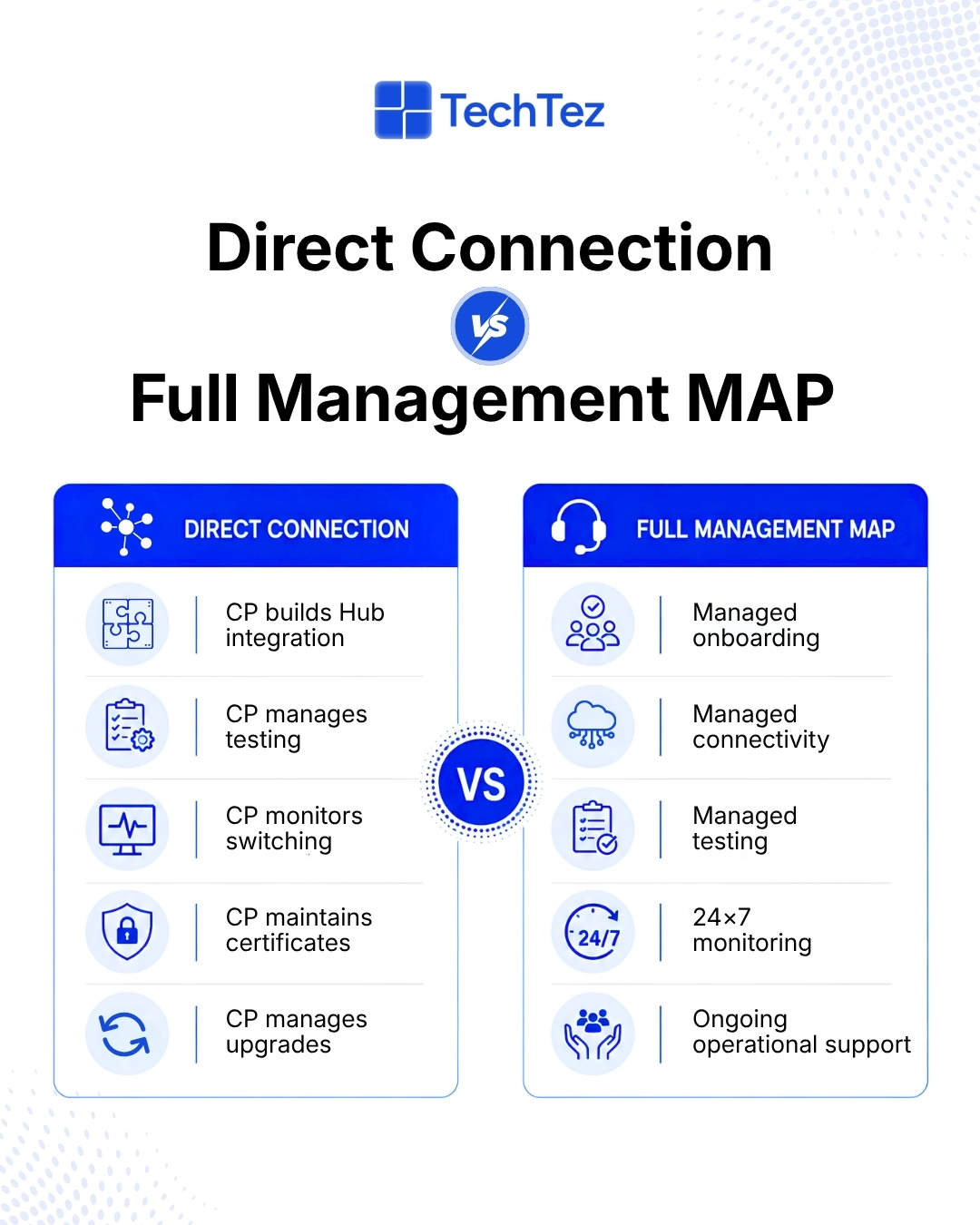
Yes. Communications Providers can connect directly to the TOTSCo Hub, giving them full control over integration and operations. However, this approach requires dedicated technical resources for development, onboarding, testing, and ongoing maintenance as specifications evolve. While direct integration is well suited to larger providers with in-house engineering teams, smaller providers may find it more resource intensive.
AWS provides both managed services and flexible infrastructure for cloud load testing. The right combination depends on your scale and your team’s familiarity with AWS tooling. For deeper guidance, the AWS Well-Architected Framework’s Performance Efficiency Pillar is the authoritative reference.
What Is a Managed Access Provider (MAP)?
A Managed Access Provider (MAP) is a third-party organization that enables Communications Providers to connect to the TOTSCo Hub without building a direct integration. Depending on the service model, a MAP may provide connectivity, APIs, onboarding support, testing, monitoring, and ongoing operational management, helping providers simplify implementation and reduce technical complexity.
How Can a Managed Access Provider Help?
A Managed Access Provider can support every stage of TOTSCo integration, including connectivity, onboarding, testing, message validation, monitoring, and certificate management. TOTSCo recognizes Insourced, Technical, and Full Management MAP models, allowing providers to choose the level of support that best fits their needs. Regardless of the model, Communications Providers remain responsible for meeting their regulatory obligations.
Preparing for TOTSCo Integration
Successfully integrating with TOTSCo requires more than establishing technical connectivity. Communications Providers (CPs) must prepare their people, processes, and technology to ensure a smooth and compliant go live. Whether connecting directly to the TOTSCo Hub or through a Managed Access Provider (MAP), early planning helps reduce implementation risks, avoid costly delays, and streamline onboarding. A well-prepared integration strategy ensures providers are ready to manage switching requests efficiently while maintaining a positive customer experience.
Process and Technical Preparation
Before going live, Communications Providers should define clear switching workflows across sales, customer support, and operations. Systems must be capable of generating, sending, and processing standardized switching messages while supporting authentication, certificate management, and error handling. Establishing clear ownership and documented processes helps ensure smooth day-to-day operations.
Testing and Operational Readiness
Comprehensive testing is essential before connecting to the live TOTSCo environment. Providers should validate connectivity, message exchanges, and end-to-end integrations to ensure systems communicate correctly with other providers. Ongoing monitoring, failure management, SLA tracking, and customer communication processes should also be established to support reliable switching operations.
Why TOTSCo Matters to Communications Providers
TOTSCo plays a vital role in helping Communications Providers deliver a secure, standardized, and customer-friendly switching experience. Beyond supporting regulatory compliance, the TOTSCo Hub provides a common messaging framework that reduces integration complexity, improves interoperability, and enables providers to exchange switching information efficiently. This standardized approach helps minimize manual processes, reduce errors, and improve overall operational performance.
For Communications Providers, successful TOTSCo integration is about more than technical connectivity. It requires selecting the right access model, preparing internal teams, and establishing robust operational processes to support ongoing switching activities. Whether connecting directly or through a Managed Access Provider, early planning enables providers to reduce implementation costs, accelerate onboarding, and remain prepared for future initiatives such as Gaining Provider Led Business (GPLB) switching. By investing in readiness today, providers can build a scalable switching capability that supports long-term business growth and delivers a better experience for customers.
Conclusion
As the UK telecom industry continues to modernize, TOTSCo has become a key enabler of secure, standardized switching for broadband and voice services. By providing a centralized messaging platform, it helps Communications Providers exchange switching information efficiently, reduce operational complexity, and deliver a more seamless customer experience. While Ofcom defines the regulatory requirements, TOTSCo provides the infrastructure that enables providers to implement them effectively.
Whether a Communications Provider chooses to connect directly to the TOTSCo Hub or through a Managed Access Provider (MAP), successful implementation depends on careful planning, thorough testing, and strong operational readiness. As business switching expands through GPLB, providers that invest in scalable processes, robust integration strategies, and ongoing operational improvements will be better positioned to meet evolving industry requirements and deliver seamless switching experiences.