
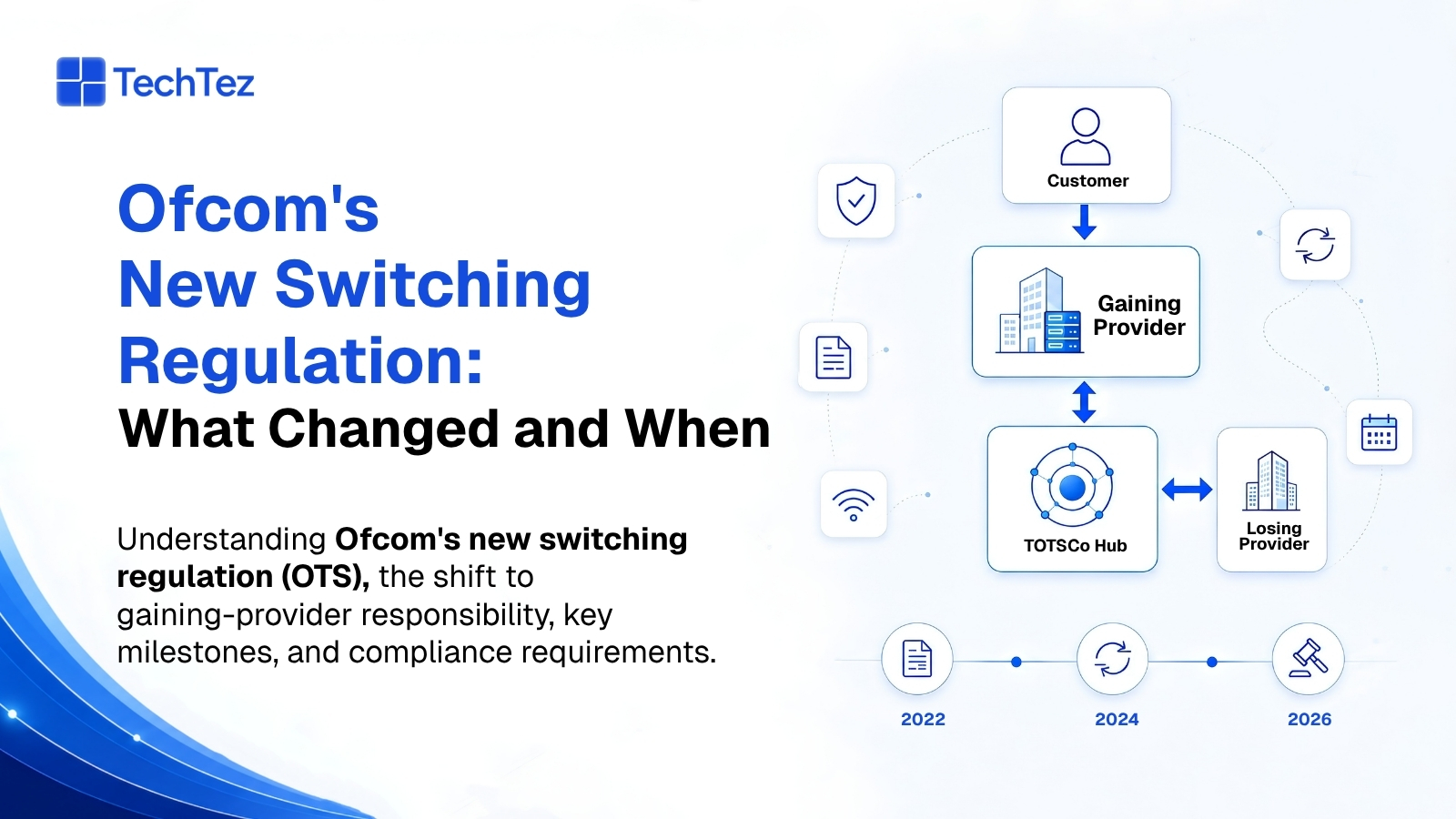

Ofcom’s One Touch Switch (OTS) is Ofcom’s rule, codified under General Condition C7.18 to C7.27 that makes the gaining provider fully responsible for a broadband or landline switch, giving customers one point of contact instead of coordinating two suppliers themselves. It replaced the old Notification of Transfer process, missed its original April 2023 deadline. It is Live since September 2024 and has processed more than 3 million switches by mid-2026. Ofcom didn’t tweak a process, it rebuilt who’s accountable for a switch from the ground up, missed its own first deadline by seventeen months, and left business switching on a genuinely different regulatory track from residential. This guide walks through what changed, when each part took effect, and what’s still moving.
Why Ofcom Built One Touch Switch (OTS)
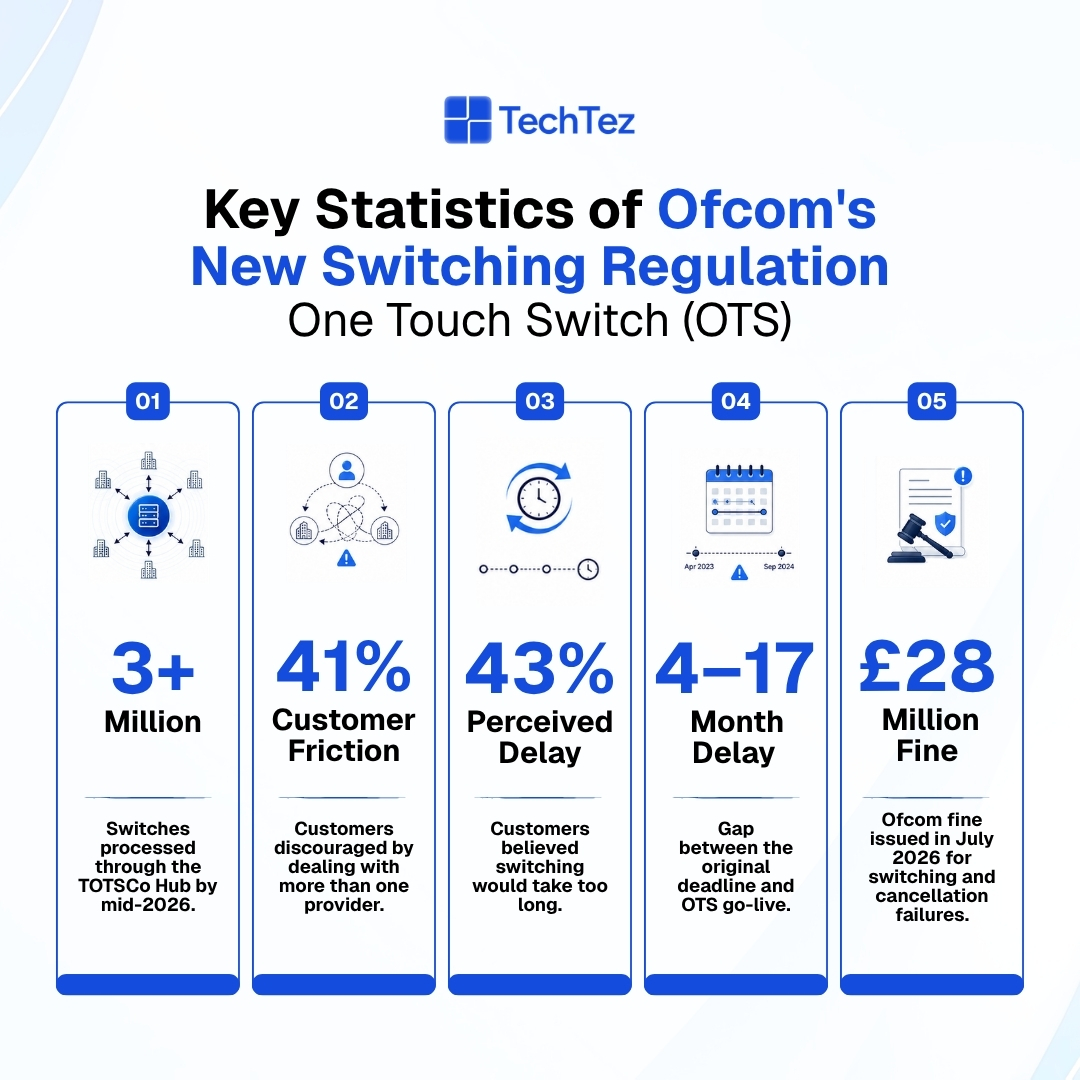
Before OTS, switching broadband or landline provider meant contacting both the old supplier and the new one, and coordinating the handover yourself, often across two customer service processes with no obligation to talk to each other. Ofcom’s own research found that 41% of customers said the hassle of dealing with more than one supplier put them off switching, and 43% assumed it would simply take too long. That friction protected incumbent providers from competition, whether by design or not, and Ofcom decided it needed fixing at the regulatory level rather than left to individual CPs on their own timelines.
On 3 February 2022, Ofcom published “Quick, easy and reliable switching,” confirming a new requirement: residential customers switching landline and broadband would get a single point of contact, and the old Notification of Transfer (NOT) process would be retired. The same statement introduced a related but separate requirement for business customers: an industry-agreed Gaining Provider Led process, the foundation for what’s now called GPLB.
OTS Compliance Checklist
Use this as a working audit, not a one-time sign-off. Ofcom’s Virgin Media enforcement shows that being connected to the Hub is not the same as being compliant. A CP that can tick every box below still needs to keep checking. Hub specifications, match-rate expectations, and Ofcom’s enforcement posture have all moved since September 2024.
- Connected to the TOTSCo Hub, with integration tested against current message specs
- Gaining-provider-led workflow fully implemented, with no residual customer-coordinated steps
- No “Cancel Other” functionality remaining anywhere in the losing-provider flow
- C7.18 to C7.27 requirements implemented and mapped to internal process documentation
- Switches consistently completing inside the required timeline, not just on average
- Customer cancellation journey reviewed specifically, separate from the switching-in journey
- Front-line and retention staff trained on the current process, not the pre-2024 one
- Audit trail retained for Hub messages and switch outcomes, in case Ofcom asks
What actually changed under Ofcom’s new switching regulation
The core shift is who owns the switch. Under the old model, the customer or the losing provider carried the coordination burden, often across two separate customer service processes that had no obligation to talk to each other. Under OTS, the gaining provider, the one the customer is switching to, takes full responsibility for making it happen, and the losing provider’s role shrinks to responding through the Hub rather than managing the customer directly.
That reallocation of responsibility is easier to see as a flow than to describe in a paragraph. The two diagrams below show the same switch under both models: the same customer, the same intent to leave, but a materially different number of steps and points of possible failure in each version.
Old process Customer → contacts old provider → contacts new provider → coordinates the handover themselves → switch completes (or stalls)
OTS process Customer → contacts new (gaining) provider only → gaining provider messages losing provider through the Hub → switch completes inside a defined window
A Single Point of Contact and Full Gaining-Provider Responsibility
Under OTS, customers deal with exactly one provider: the one they’re switching to. That provider handles every piece of communication with the losing provider, including the parts that used to fall on the customer, chasing cancellation dates, confirming equipment returns, or resolving a stalled handover. This is the structural core of the regulation, and it’s why Ofcom frames OTS as a shift in accountability rather than a new customer service standard layered on top of the old one.
Two other pieces sit inside this same change. First, switches are expected to complete within a defined window, replacing a process that had no consistent timeline across the industry and could stretch on for weeks depending on which two providers were involved. Second, and this trips up CPs who built their processes around the old rules, losing providers no longer have a “Cancel Other” option to unilaterally halt a switch at the customer’s request. Ofcom made this change explicit after finding the mechanism had no basis in its own General Conditions in the first place. Any CP still running a version of that override is not compliant, regardless of how the feature is labeled internally.
For CPs building or auditing their switching flow, the practical test is simple: can a customer complete a full switch, start to finish, without a single interaction with their old provider? If the answer is no, the gap is usually here.
The Technical Backbone: TOTSCo and the Hub
Rather than every CP building its own point-to-point integrations with every other CP, the industry stood up TOTSCo (The One Touch Switching Company) in June 2022 to build and operate the messaging platform, known as the Hub, that CPs use to exchange switching messages under OTS. This is what makes single-point-of-contact switching operationally possible: one gaining provider, one Hub connection, and the message routing to whichever losing provider is on the other end, instead of a custom integration per competitor pair.
The Hub opened for integration testing and onboarding in July 2023, more than a year before OTS itself went live for residential customers in September 2024. That gap wasn’t wasted time. It reflects how much technical work sat between the regulatory requirement and a system that could actually carry live customer switches at scale, and it’s part of why the original April 2023 deadline slipped: the Hub simply wasn’t ready for full production traffic on that timeline.
Formal compliance runs through this same infrastructure. OTS isn’t guidance CPs can interpret loosely, it’s codified in Ofcom’s General Conditions of Entitlement, specifically C7.18 through C7.27, which means a broken Hub connection or a non-compliant switching flow is a regulatory matter, not a customer service shortfall to fix on your own schedule.
Common OTS Implementation Challenges
Every CP running Hub integration tends to hit the same handful of problems. Knowing them in advance is faster than discovering them mid-migration.
- Hub integration itself, particularly keeping pace with message spec changes without breaking existing flows
- Customer identity matching, since a switch depends on correctly matching the customer to their current provider and account, and mismatches stall or misroute switches
- Failed switch handling, including how quickly a failure is surfaced to the customer versus silently retried
- Duplicate orders, which happen when a customer contacts more than one prospective gaining provider and two switches get initiated against the same account
- Legacy OSS/BSS integration, where older billing and provisioning systems weren’t built with gaining-provider-led workflows in mind
- Cancellation workflows, which need to be rebuilt around the loss of “Cancel Other,” not just patched
- Cross-provider testing, since Hub behavior with one losing provider doesn’t guarantee identical behavior with another
- Operational training, particularly for retention and customer service teams who may default to old habits under pressure
Edge cases Communication Providers shouldn’t overlook
OTS covers the standard broadband-and-landline switch cleanly. It’s the adjacent cases where CPs run into gaps the regulation didn’t fully anticipate.
- Voice services: Ofcom’s original OTS regulation was written before IP voice complicated the picture. Applications and services tied to a voice number, things like WLR replacement products or number-based calling features bundled into a router or app, don’t always switch cleanly under the regulation as written. Some voice-only applications keep working after the number-based calling function is removed. Others don’t, and industry guidance has had to fill that gap since.
- Number portability: A switch that also involves porting a phone number adds a second process running in parallel with the broadband switch, and misalignment between the two is a common source of customer-facing delay.
- Bundled services: TV, mobile SIMs, or security add-ons bundled into a broadband contract don’t automatically follow the switch the way the broadband line does, and customers frequently assume they will.
- Equipment returns: The gaining provider owns the switch, but equipment returns logistics for the losing provider’s kit still need a defined owner, or it becomes a source of complaints that count against the losing provider’s cancellation experience.
- Legacy WLR migration: CPs still running Wholesale Line Rental infrastructure face a migration path that intersects with, but isn’t identical to, standard OTS switching.
What actually improved for customers
The case for OTS isn’t only regulatory. It exists because Ofcom’s own research showed switching friction was suppressing competition, and since go-live the intended benefits show up in how switching actually behaves in practice, not just in the policy rationale:
- Fewer abandoned switches, since customers no longer coordinate two providers themselves and can’t get stuck between two customer service teams
- Faster migrations, inside a defined completion window instead of an open-ended process that used to stretch across weeks
- Less customer effort overall, with a single point of contact for the entire process instead of two
- Improved competitive pressure on incumbent providers, since switching friction no longer works as an informal retention strategy
- Fewer switching-related complaints reaching Ofcom directly, as more of the process is standardized across the industry rather than handled inconsistently by each pair of providers
This matters for CPs positioning switching internally, not just externally. OTS compliance isn’t purely a cost center or a regulatory obligation to minimize. A clean switching experience is now a competitive signal, and CPs that treat it as one tend to have an easier time with the cancellation side of compliance too, since the same operational discipline covers both directions.
The Rollout Timeline: Four Regulatory Phases
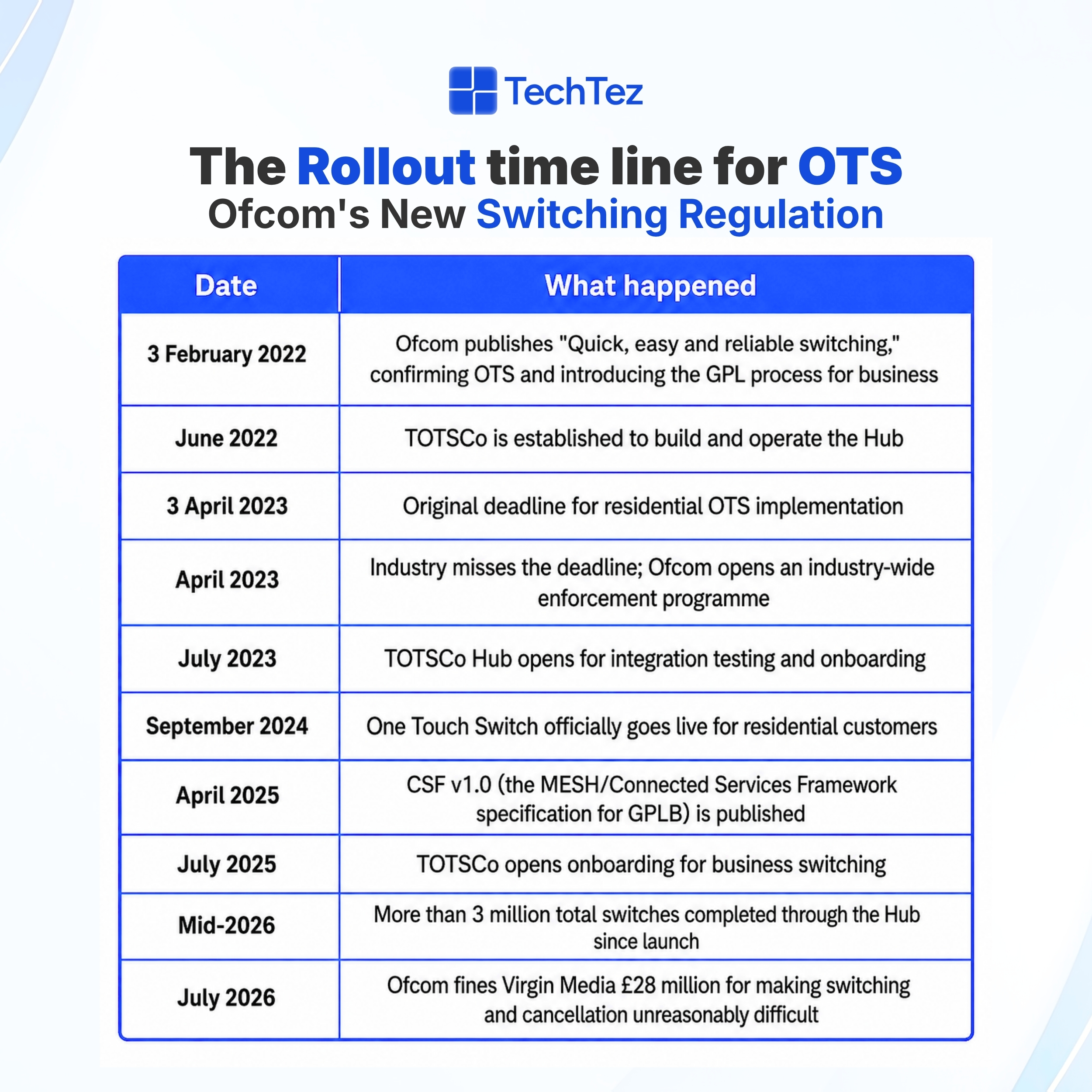
Phase 1: Regulation announced (2022) On 3 February 2022, Ofcom published “Quick, easy and reliable switching,” confirming OTS as a requirement and introducing the GPL process for business. TOTSCo was established in June 2022 to build and operate the Hub.
Phase 2: Industry build (2022 to 2023) The Hub opened for integration testing and onboarding in July 2023, giving CPs a live environment to connect and test against ahead of the original deadline.
Phase 3: Delay and enforcement (2023 to 2024) The original 3 April 2023 deadline was missed, industry-wide. Ofcom opened an enforcement programme in response, and OTS didn’t reach production until September 2024, roughly seventeen months later than originally required.
Phase 4: Live operations (2024 onwards) OTS went live for residential customers in September 2024. GPLB’s CSF v1.0 specification followed in April 2025, TOTSCo opened business switching onboarding in July 2025, and by mid-2026 the Hub had processed more than 3 million switches, with Ofcom fining Virgin Media £28 million the same month for cancellation and switching failures.
Business Switching Runs on a Different Regulatory Track
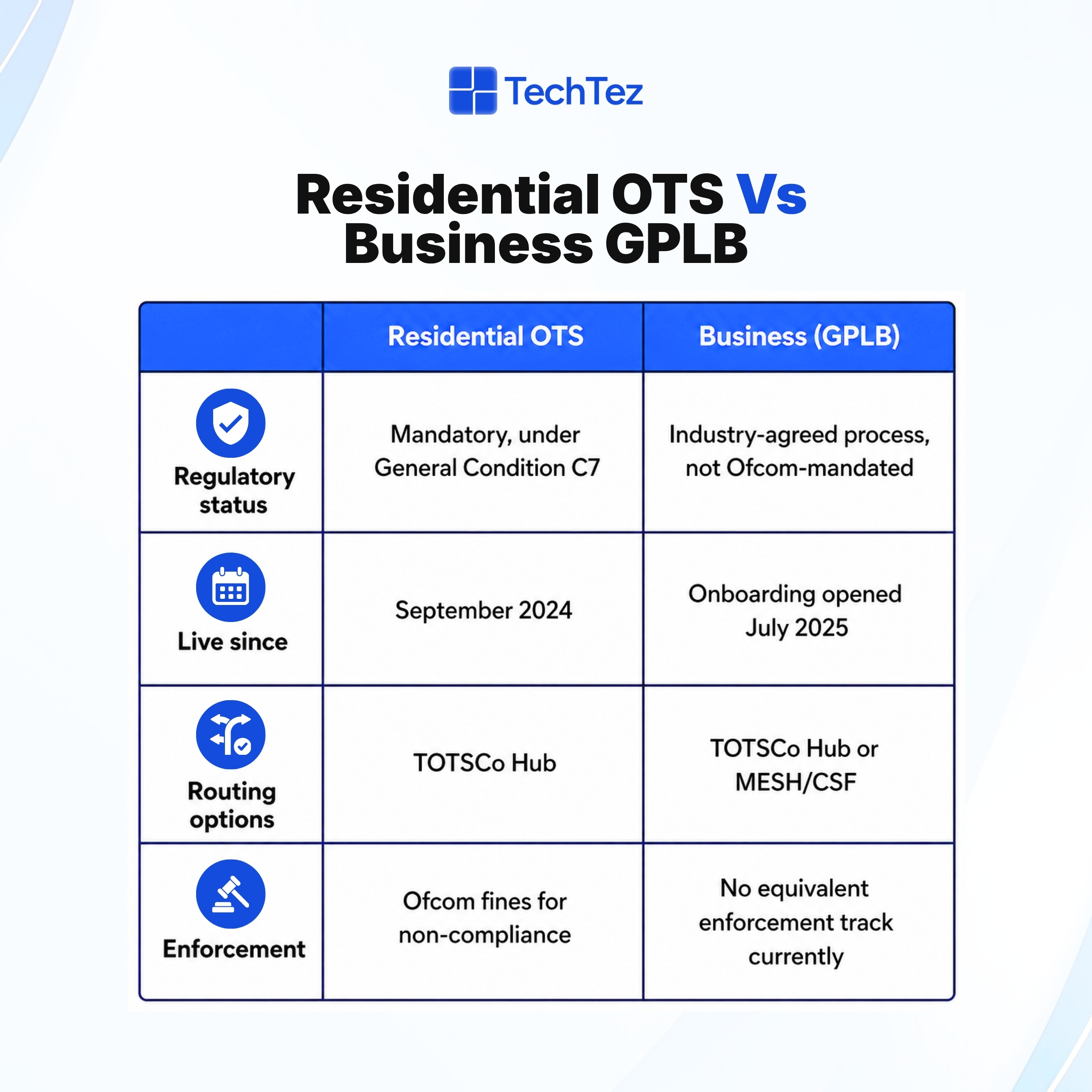
This is where most of the confusion comes from, and it’s an easy mix-up to make. OTS, as codified in C7.18 to C7.27, applies to residential customers switching landline and broadband services. It does not currently apply to business broadband customers. In a recent press release in Ofcom confirmed as much as recently as January 2026: One Touch Switch isn’t available, or mandatory, for business customers, and it never applied to mobile broadband either.
Why GPLB isn’t mandatory yet
What exists for business customers instead is Gaining Provider Led Business switching, GPLB, built by an industry steering group rather than mandated wholesale by Ofcom the way OTS was. Business connections come with longer contracts, varied connectivity types, and service level agreements that don’t map cleanly onto a single residential-style process. That complexity is part of why Ofcom left the detail to industry consensus instead of prescribing it directly the way it did for residential.
Business switching remains, in TOTSCo’s own framing, a competitive market. There’s no requirement for any CP or Managed Access Provider to use TOTSCo’s business switching solution specifically, even though TOTSCo built one and plenty of providers use it anyway for the same interoperability benefits that made the residential Hub attractive in the first place. The GPLB process has real structure behind it regardless: the CSF specification for decentralized MESH-based message exchange as an alternative to routing everything through the Hub, asset list requests to cut down on erroneous transfers, and early visibility for losing providers so they can manage the customer relationship before the switch completes. None of it carries the regulatory teeth that C7.18 to C7.27 carries for residential, at least not yet.
The direction of travel matters more than the current status. TOTSCo’s business switching solution opened for onboarding in July 2025, and the CSF specification reached v1.0 in April 2025. Both are signs of a track maturing quickly, even without a mandate forcing it.
What Non-Compliance costs
Ofcom has made clear it isn’t treating OTS as a box-ticking exercise. Beyond the industry-wide enforcement programme opened over the missed 2023 deadline, Ofcom took direct action against Virgin Media in July 2026, fining the provider £28 million for making it unreasonably difficult for customers to cancel and switch away. That’s a concrete financial penalty against a major national provider, and it sets a clear precedent: Ofcom will pursue enforcement against providers who comply with the letter of OTS while still creating friction for customers trying to leave.
The pattern across both enforcement actions, the industry-wide programme in 2023 and the Virgin Media fine in 2026, is consistent. Ofcom isn’t just checking whether a CP has technically connected to the Hub. It’s evaluating whether the customer’s actual experience of switching, and specifically of leaving, matches what the regulation intended. A CP that’s technically compliant on paper but still makes cancellation slow or confusing is exactly the profile Ofcom has now shown it will fine.
For CPs, the practical takeaway is that compliance isn’t just about connecting to the Hub and calling it done. Ofcom is evaluating the actual customer experience end to end, including cancellation, not just whether the technical integration exists.
What this means for Communication Providers right now
If you’re a residential CP, OTS compliance hasn’t been optional since September 2024. That means Hub connectivity, adherence to C7.18 to C7.27, and, based on the Virgin Media precedent, genuine attention to how easy your own cancellation and switching-away process actually is for customers, not just switching-in.
If you primarily serve business customers, you have more flexibility, but not indefinitely. GPLB is maturing fast: the CSF specification is published, TOTSCo’s business switching solution has been live for onboarding since July 2025, and the direction of travel across the industry suggests business switching regulation could tighten the way residential did. Building GPLB capability now, whether through the Hub, MESH/CSF, or a managed partner, puts you ahead of a shift that residential CPs experienced as a scramble against a deadline they’d already missed once.
Final Thoughts
What changed is straightforward: Ofcom moved full responsibility for a residential broadband or landline switch onto the gaining provider, gave customers a single point of contact, retired the old Notification of Transfer process, and built the TOTSCo Hub to carry it all. When it changed is less tidy. The original deadline was April 2023, the industry missed it, and OTS didn’t actually go live until September 2024, seventeen months later than planned.
That gap between “what was required” and “when it actually worked” is the part CPs should hold onto. Ofcom didn’t soften the requirement because the industry missed the first deadline, it opened an enforcement programme and kept pushing until the Hub was ready. The same pattern is now visible in how Ofcom treats compliance after go-live: a £28 million fine in July 2026 shows a technical connection to the Hub was never the actual bar, matching the customer’s real experience of leaving was.
Business switching under GPLB sits exactly where residential OTS sat in 2022, an industry-built process with no Ofcom mandate behind it yet. Given how residential played out, “not mandatory” is worth reading as “not mandatory yet,” not as a reason to wait.