Everywhere you look today, there’s a bold claim: “Plug our AI into your system and become 10x faster.”
Install an API → Connect to your old system → Generate insights → Instant transformation.
It looks magical until it hits real enterprise reality:
Legacy systems without APIs
Batch-based workflows that break with real-time AI
Poor data quality that sabotages model output
Shadow IT pipelines full of inconsistencies
Compliance barriers around data movement
Inability to explain how AI planned
Infrastructure that simply wasn’t built for AI workloads
That’s what happens when teams force “modern AI” into “legacy systems” without assessing compatibility, data readiness, or architecture constraints.
To make AI work in real enterprises where 20-year-old systems run mission-critical operations, you need tailored, orchestrated, incremental integration, not a plug-and-pray deployment.
This guide explains how to integrate AI into legacy systems the right way not through forced modernization or quick APIs, but through a structured, secure, and scalable approach.
Why Tailored AI Integration in Legacy Systems Matters
Legacy systems store decades of customer profiles, financial records, operations logs, and product data. Without AI integration, this data becomes a bottleneck instead of a competitive asset.
Most enterprises think AI integration is Picking an AI model, adding a connector and Calling the API
But in practice, AI in legacy systems requires:
Extracting data from rigid monolithic architectures
Normalizing highly inconsistent formats
Mapping incomplete schemas
Designing pipelines that don’t interrupt existing workflows
Creating real-time or near-real-time access where only batch existed
Implementing guardrails around privacy, compliance, and audit
Ensuring explainability in regulated sectors
Building monitoring, evaluation, and fallback paths
AI only works as well as the ecosystem around it.
If you skip these steps, you get noisy insights, model failures, compliance risks, and costly firefighting.
Enterprises don’t need to rip and replace; they need a smarter, safer integration strategy.
Preparing for Tailored AI Integration in Legacy Systems
Before introducing AI into any legacy environment, organizations must conduct a structured readiness evaluation. Many AI failures occur not because the models are weak, but because the environment they are deployed into was never prepared for them.
AI integration is not simply a technical add-on. It is a systemic transformation that touches data pipelines, infrastructure, compliance policies, workflows, and user experience.
A readiness assessment typically revolves around three dimensions: data quality, system extensibility, and compliance boundaries. Each of these areas determines how AI can safely and effectively operate within the ecosystem.
A typical readiness check focuses on three core areas:
Data Condition and Accessibility:
Legacy data is often siloed across departments, duplicated across systems, or partially corrupted due to years of patches and manual processes. In many industries, especially financial services, studies suggest that a significant portion of legacy data contains inconsistencies or incomplete records. AI systems amplify patterns in data, so poor data quality directly results in unreliable outputs.
A readiness assessment should evaluate data completeness, consistency, ownership, lineage, and accessibility. Key questions include: Is the data structured or semi-structured? Are schemas standardized? Who owns each dataset? Are there audit trails? Can data be extracted without disrupting operations? Clean, well-tagged, and governed data is not optional; it is foundational for trustworthy AI performance.
System Extensibility:
Legacy systems were rarely designed for high-frequency API calls, real-time processing, or AI-driven workloads. Some lack APIs entirely, while others rely on batch jobs that run overnight. Attempting to introduce AI directly into such environments can strain infrastructure, increase latency, or even cause downtime.
A readiness check should examine API availability, latency tolerance, system load thresholds, workflow dependencies, and architectural flexibility. Can modules be wrapped with microservices? Is middleware required? Can event-driven connectors enable near-real-time updates without disrupting core processes? Extensibility determines whether AI can coexist with legacy operations safely and sustainably.
Compliance & Security Boundaries:
AI integration must operate within strict regulatory and security frameworks, especially in healthcare, BFSI, telecom, and public sector environments. Data residency rules, encryption standards, identity-based access controls, and audit requirements cannot be bypassed for the sake of innovation. A proper assessment evaluates data sensitivity classifications, PII/PHI exposure risks, access permissions, logging requirements, and alignment with regulatory standards such as GDPR, SOC 2, ISO, or industry-specific mandates. AI systems must be identity-aware, policy-driven, and fully auditable. Without embedded compliance and security guardrails, modernization efforts introduce more risk than value.
Discover how TechTez transformed a legacy Database Backup & Recovery Platform into a scalable, Kubernetes-native solution showcasing our expertise in modernizing complex enterprise systems.
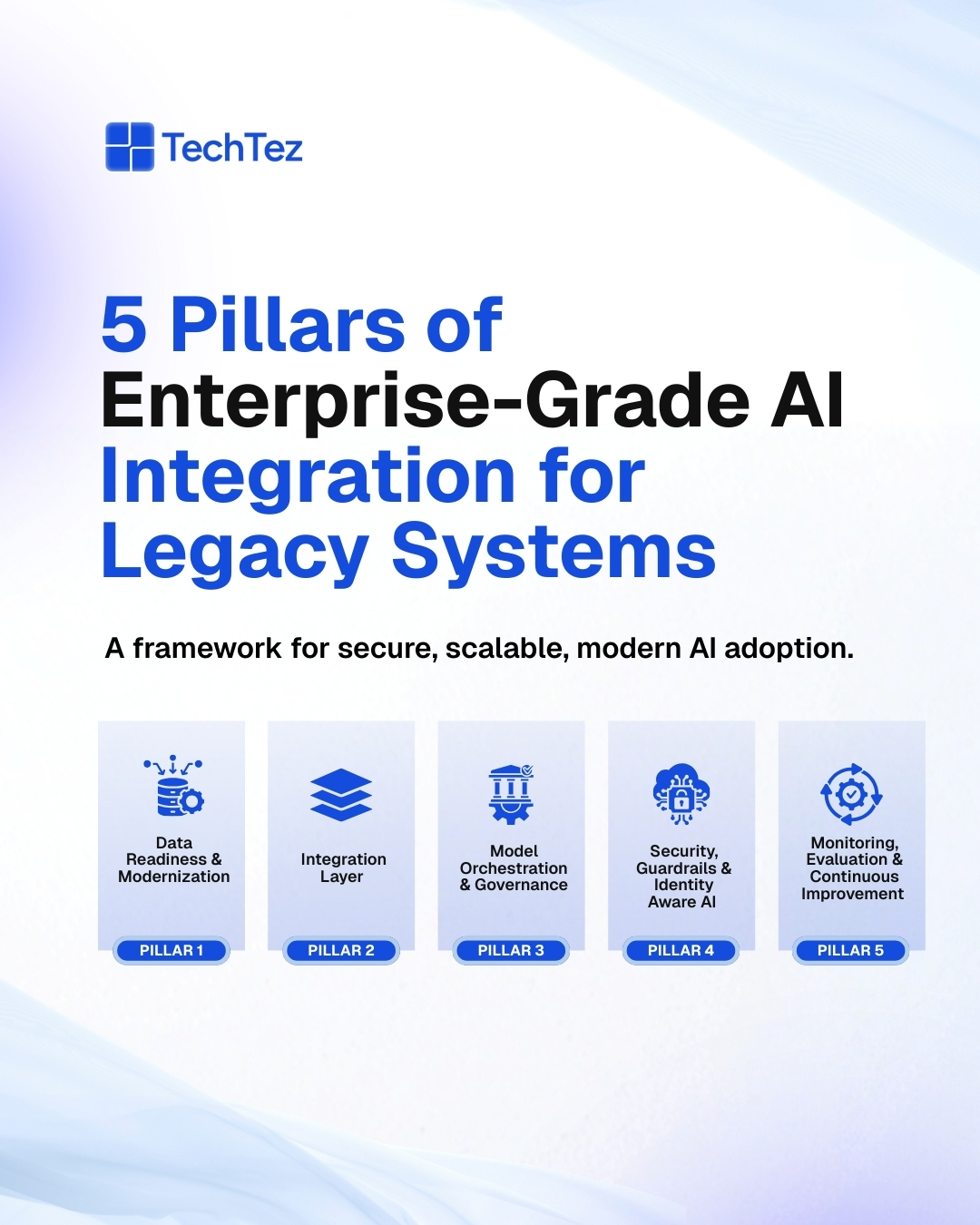
The 5 Pillars of Enterprise-Grade AI Integration for Legacy Systems
Enterprise AI modernization succeeds when built on a structured foundation. These five pillars represent not isolated tasks, but interdependent layers that collectively ensure stability, scalability, and compliance.
Pillar 1: Data Readiness & Modernization (Before Any AI)
AI readiness begins with disciplined data modernization. This involves constructing reliable ETL or ELT pipelines, cleaning inconsistencies, introducing standardized schemas, and implementing metadata frameworks that clarify ownership, sensitivity, and lineage.
Modernization also requires establishing data contracts to ensure consistency across modules. Without shared definitions and validation rules, AI systems receive conflicting inputs and produce unreliable outputs.
When data is fragmented, AI will be fragmented. When data is governed, AI becomes dependable.
Importantly, data modernization delivers value beyond AI. It enhances reporting, reduces reconciliation errors, and improves cross-functional visibility.
Pillar 2: Integration Layer (APIs, Middleware, and Adapters)
The integration layer is the protective bridge between legacy systems and AI services. Rather than allowing AI models to directly interact with monolithic cores, this layer absorbs complexity and shields fragile systems from overload.
It may consist of custom adapters for non-API systems, middleware to normalize data exchanges, microservices to modularize functions, and event streaming systems that enable near-real-time updates without disrupting batch workflows.
This architectural buffer ensures that AI can scale independently of legacy limitations. It also creates flexibility for future modernization efforts.
A well-designed integration layer turns rigid systems into extensible platforms without replacing them.
Pillar 3: Model Orchestration & Governance
AI in regulated enterprises requires centralized orchestration. This includes managing model versions, controlling permissions, implementing explainability standards, and maintaining audit logs for every inference.
Model governance ensures that decisions can be traced, justified, and rolled back if necessary. It also supports bias detection, compliance validation, and structured testing before deployment. Without governance, AI becomes opaque. With governance, it becomes accountable. Orchestration transforms AI from a black box into an enterprise-managed asset.
Pillar 4: Security, Guardrails & Identity-Aware AI
Security must be embedded at every level of the AI integration architecture. Identity-aware access control ensures that models only access the data users are authorized to see. Sensitive information must be masked or redacted before reaching inference layers.
Guardrails also protect against misuse, including prompt injection, data leakage, or policy violations. Encryption, audit trails, and secure infrastructure isolation further strengthen the environment. AI should never expose more information than the underlying system allows. When identity and policy enforcement are tightly integrated, AI operates safely within enterprise boundaries.
AI systems evolve alongside data and workflows. Without monitoring, models drift, performance degrades, and errors accumulate silently. Enterprise-grade AI requires ongoing observability across latency, cost, accuracy, and drift metrics. Human-in-the-loop review cycles provide qualitative validation, while automated rollback mechanisms protect production systems from unexpected failures.
Continuous evaluation ensures that AI remains aligned with business objectives as regulations, customer behaviour, and operational conditions change. AI integration is not a milestone. It is a lifecycle.
A Clear Blueprint – AI + Legacy System Architecture
Successful AI integration follows a layered architectural blueprint that separates responsibilities and protects system stability.
Rather than embedding AI directly into legacy applications, organizations build a structured middle architecture. This allows AI to analyse data, generate insights, and automate workflows without interfering with core logic.
Each layer serves a distinct function: ingestion, integration, intelligence, security, experience, and operations working together as a cohesive ecosystem.
Ingestion Layer:
The ingestion layer extracts and standardizes data from fragmented legacy sources such as ERP systems, CRM platforms, relational databases, mainframes, flat files, logs, and third-party integrations. In most legacy environments, this data is siloed and structured inconsistently, often shaped by years of patches, customizations, and batch processes. Without structured ingestion, AI models inherit these inconsistencies.
This layer resolves structural conflicts through schema mapping, normalization, deduplication, and metadata enrichment. Canonical data models are often introduced to unify formats across modules, while timestamps, source attribution, sensitivity tags, and lineage tracking strengthen governance and traceability.
Advanced implementations may include change-data-capture (CDC) to enable near-real-time updates without full replication, preserving stability. A strong ingestion foundation ensures AI operates on reliable, enterprise-grade inputs rather than fragmented signals.
Integration & Orchestration Layer:
The integration and orchestration layer acts as the control center between legacy systems and AI services. It prevents direct coupling between fragile monolithic cores and compute-heavy model workloads, protecting operational stability.
This layer may include middleware, API gateways, adapters for non-API systems, ESBs, or event-streaming platforms that enable asynchronous communication. By absorbing complexity, it allows AI to respond to business events without disrupting transactional workflows.
Orchestration manages routing, retries, rate limits, fallbacks, and version compatibility. Because intelligence is decoupled from core operations, models can be updated or scaled without destabilizing the system making incremental AI modernization practical and low risk.
AI/ML Layer:
The AI/ML layer houses models and inference services that generate predictions, classifications, summaries, or automated decisions. In legacy environments, it must balance computational performance with governance and compliance requirements.
This layer may include domain-specific models, contextual retrieval systems, or semantic indexing engines to unlock value from structured and unstructured data. It also includes lifecycle management capabilities such as testing, benchmarking, versioning, and rollback support.
Containerization and auto-scaling allow computing resources to expand independently of legacy infrastructure. The goal is to keep intelligence powerful yet controlled operating strictly through governed interfaces.
Security & Guardrail Layer:
Security is embedded across the architecture rather than treated as a checkpoint. The guardrail layer enforces identity-aware access controls, so AI systems only retrieve data users are authorized to see. Sensitive fields such as PII or PHI are masked or redacted before inference.
Encryption protects data in transit and at rest, while audit logs capture model interactions for traceability and compliance. Explainability mechanisms help regulated industries justify automated decisions when required.
Additional safeguards address emerging risks such as prompt injection or data leakage by filtering inputs and constraining outputs. This layer ensures AI improves performance without increasing systemic risk.
Enterprise AI governance should align with structured risk frameworks such as the NIST AI Risk Management Framework, which emphasizes explainability, accountability, and continuous monitoring.
Experience Layer:
AI creates value only when embedded seamlessly into user workflows. The experience layer integrates model outputs into dashboards, ERP screens, CRM tools, case systems, or conversational assistants without forcing workflow disruption.
Outputs are translated into actionable insights such as alerts, summaries, recommendations, or risk scores within familiar interfaces. This preserves continuity while enhancing decision-making speed.
Feedback mechanisms allow users to validate or override outputs, creating human-in-the-loop refinement. When AI feels like augmentation rather than replacement, adoption and trust increase.
Ops & Monitoring Layer:
AI integration does not end at deployment. The operations layer ensures ongoing reliability, visibility, and cost control. It tracks model drift, data drift, latency, error rates, and usage patterns across environments.
Automated alerts surface anomalies early, while evaluation routines confirm performance remains aligned with business goals. Cost observability helps manage inference workloads that may fluctuate unpredictably.
Human oversight, periodic retraining, and structured performance reviews ensure AI evolves alongside business rules and regulatory expectations. Sustained value depends not on launch, but on disciplined operational governance.
From Architecture to Execution – Turning Strategy into Measurable Outcomes
Designing a layered AI architecture is only the first step. Real transformation happens when that design is operationalized with discipline, ownership, and measurable outcomes.
Many enterprises stall at the blueprint stage. They define integration layers and governance models but fail to translate them into business value. Closing that gap requires structured execution.
To move from architecture to impact:
Treat AI integration as an operational program, not a one-time technical deployment
Assign clear cross-functional ownership across engineering, data, security, compliance, and business teams
Start with insulated deployment, using the integration layer to protect core systems
Implement governed data pipelines before scaling model usage
Deploy with guardrails and explainability from day one
Monitor continuously for drift, latency, compliance deviations, and cost spikes
Iterate in controlled cycles rather than large, risky rollouts
AI modernization succeeds when execution is disciplined, monitored, and iterative.
Architecture provides the structure. Execution delivers value.
According to McKinsey’s State of AI report, organizations that combine strong data governance with structured AI deployment frameworks, report significantly higher performance gains and risk control.
Business Benefits: Why Tailored AI Integration Matters
When AI is integrated thoughtfully through structured architecture, governed data pipelines, and secure orchestration rather than quick connectors, it unlocks measurable enterprise value across multiple dimensions. Decision-making becomes significantly faster and more accurate as legacy batch-driven systems evolve into real-time or near-real-time insight engines, enabling leaders to act on current data instead of outdated reports. Productivity rises as intelligent automation reduces repetitive manual tasks such as data entry, ticket routing, reconciliation, approvals, and routine reporting, allowing teams to focus on higher-value strategic work. At the same time, years of siloed and underutilized legacy data are transformed into actionable intelligence, strengthening forecasting, risk detection, operational planning, and customer experience initiatives.
Financially, tailored AI integration reduces the need for expensive rip-and-replace modernization programs by extending the life of core systems often by five to ten years while still delivering modern capabilities. Instead of introducing instability, a governed AI framework enhances operational resilience. Built-in monitoring, audit trails, access controls, and explainability mechanisms ensure that automation remains compliant, transparent, and predictable. The result is not just incremental efficiency, but a structural shift: legacy infrastructure evolves from a constraint into a strategic asset, powered by intelligence without sacrificing stability.
How to Get Started with AI Integration in Legacy Systems
Getting started with AI in a legacy environment does not require a full-scale transformation initiative. What it requires is disciplined sequencing.
Organizations often make the mistake of starting with models instead of problems. Sustainable AI integration begins with clarity. Clarity about where value lies, where constraints exist, and how modernization can occur incrementally without destabilizing core operations.
The following steps provide a structured path from exploration to enterprise-scale deployment:
Start with clear business problems, not models: Identify one or two high-impact use cases where inefficiencies are measurable, manual effort is high, and usable data already exists. Focused pilots reduce risk and generate early wins.
Assess system readiness before deployment: Evaluate data quality, API availability, workflow dependencies, compliance constraints, and infrastructure capacity. This assessment becomes your practical modernization roadmap.
Build a secure integration layer first: Introduce APIs, adapters, middleware, or event-driven connectors to insulate legacy systems from AI workloads and prevent performance strain.
Deploy with governance from day one: Implement strict access controls, explainability, version management, and audit logging to ensure compliance, transparency, and trust.
Pilot, measure, and iterate: Launch within a limited scope, track performance against defined KPIs, refine pipelines based on real feedback, and scale incrementally.
Treat AI integration as a product, not a project: Assign ownership, monitor continuously, and evolve responsibly to achieve sustainable enterprise modernization.
Getting Started with Tailored AI Integration in Legacy Systems
AI integration in legacy systems can seem overwhelming due to aging infrastructure, regulatory constraints, and fragmented data. However, successful modernization doesn’t require massive overhauls. It requires disciplined focus and incremental execution.
The most effective transformations start small, strengthen infrastructure before deploying intelligence, and scale only after proving measurable value. Tailored AI integration enhances existing systems rather than replacing them, turning AI into a modernization accelerator instead of a disruption.
Begin with a Focused, High-Impact Entry Point:
A single, high-impact use case (e.g., fraud alerts, ticket routing, predictive maintenance)
Clean, accessible data from one or two modules
A lightweight integration layer
A monitored model with explainability
Within 6 – 12 weeks, most enterprises begin seeing measurable improvements in speed, accuracy, and operational efficiency.
FAQs:
1. What is legacy system modernization?
Legacy system modernization is the process of upgrading old software or infrastructure without replacing it entirely to make it compatible with cloud, APIs, microservices, and AI. It helps improve performance, security, and scalability.
2. Do I need to replace my legacy system to adopt AI?
No. Most enterprises integrate AI around existing legacy systems using APIs, adapters, middleware, or orchestration layers. Full system replacement is rarely required.
3. Will AI slow down my current workflows?
Not if the integration layer is well-designed. AI processing generally runs outside the core system, ensuring your existing workflows remain fast and uninterrupted.
4. What if my legacy system has no APIs?
You can still integrate AI using custom adapters, RPA-based data extractors, enterprise service bus (ESB) connectors, or direct database-layer integrations.
5. How do I ensure compliance and security during AI integration?
Use identity-aware AI access, data masking, governance workflows, policy-based retrieval, encryption, and full audit trails to maintain compliance with standards like SOC 2, ISO, and GDPR.
6. How long does it take to see value from AI modernization?
Most enterprises see measurable ROI within 6–12 weeks from their first pilot use case, especially in retrieval of automation, data quality improvements, and workflow acceleration.