

In the early days of a company, buying software often feels like the fastest way to solve operational challenges, improve efficiency, and support growth. You subscribe to a few tools, automate basic workflows, and suddenly operations look organized. Dashboards glow with metrics, reports generate in seconds, teams collaborate smoothly.
However, as the company grows, its operational needs become more sophisticated. Business models evolve, customer expectations shift, and workflows increasingly span multiple departments. Over time, the tools that once drove efficiency can struggle to keep pace with the organization’s changing requirements.
This is where the real debate begins: custom software vs off-the-shelf solutions. It’s a strategic one that impacts scalability, operational flexibility, and long-term competitive advantage.
According to research from McKinsey & Company, companies that treat technology as a strategic capability and a support function are significantly more likely to outperform competitors in revenue growth and digital maturity. The difference often lies in how intentionally they approach the build vs buy decision.
What is Custom Software?
Custom software is developed specifically to support your organization’s unique processes, workflows, and long-term objectives. Instead of forcing your teams to adjust their operations to fit a standardized platform, custom solutions are designed around how your business functions. This means the software aligns with your internal logic, decision-making structures, and growth strategy from the very beginning.
With custom development, companies can embed their competitive strengths directly into their technology ecosystem. Whether it’s a specialized pricing engine, a personalized customer journey, advanced workflow automation, or custom reporting dashboards, every feature is intentionally built to reflect strategic priorities. This level of alignment ensures that technology enhances differentiation rather than limiting it.
Although custom software typically requires a higher upfront investment compared to off-the-shelf solutions, it offers complete control over scalability, integrations, security, and future enhancements. For businesses operating in fast-changing markets or relying heavily on innovation and customer experience, this flexibility becomes a powerful long-term competitive advantage.
What is Off-the-Shelf Software?
Off-the-shelf software, commonly delivered through a SaaS (Software as a Service) model, is pre-built and designed to serve a wide variety of businesses across industries. These solutions come with standardized features that address common operational needs such as HR management, payroll processing, accounting, customer relationship management (CRM), and project collaboration. Because they are created for mass adoption, they follow established best practices and industry norms, making them reliable and easy to deploy.
One of the biggest advantages of off-the-shelf software is speed. Organizations can implement these systems quickly without long development cycles. Subscription-based pricing models offer predictable monthly or annual costs, and vendors handle maintenance tasks like updates, security patches, and infrastructure scaling. This reduces the burden on internal IT teams.
However, these platforms are built on generalized assumptions. While they perform well for standardized processes, they may struggle to accommodate complex, rapidly evolving, or highly differentiated business models without expensive customizations or workarounds.
Custom Software vs Off-the-Shelf Solutions: Key Differences
When comparing custom software vs off-the-shelf solutions, the most significant differences appear in four key areas: flexibility, scalability, ownership, and long-term cost. While both approaches can support business growth, they serve fundamentally different strategic purposes depending on how your organization operates and how quickly it needs to evolve.
Off-the-shelf software provides immediate deployment and standardized functionality built around common industry requirements. It is ideal for businesses that prioritize speed, predictable subscription pricing, and operational stability. Companies can implement these tools quickly and benefit from vendor-managed updates, security patches, and infrastructure support. However, as organizations expand, they often add multiple SaaS tools to address emerging operational needs. This accumulation introduces integration challenges, data silos, overlapping functionalities, and growing vendor dependencies. Over time, managing multiple disconnected platforms may reduce agility and increase hidden operational costs.
Custom software, in contrast, is built to evolve alongside your business. It enables rapid workflow modifications, deeper integration with internal systems, and full ownership of architecture and data. This reduces vendor lock-in and improves adaptability. In simple terms, off-the-shelf software optimizes for convenience and speed, while custom software optimizes for long-term control, scalability, and strategic flexibility.
1. Flexibility and Workflow Adaptability
Flexibility is one of the most important factors in the custom software vs. off-the-shelf software debate. As businesses evolve, their processes, customer expectations, and operational requirements change. The ability to adapt technology quickly can determine how effectively an organization responds to new opportunities and challenges. While both custom and off-the-shelf solutions offer some level of configuration, the extent to which they support business-specific requirements varies significantly. Understanding these differences helps CTOs evaluate whether their technology stack can support long-term innovation and growth.
Key advantages of custom software flexibility:
- Supports unique business workflows and processes
- Allows modifications to approval hierarchies and automation rules
- Adapts easily to new pricing models and business strategies
- Enables faster deployment of new features and updates
- Reduces dependency on vendor-controlled roadmaps
- Facilitates experimentation and continuous improvement
- Integrates seamlessly with existing internal systems
Common limitations of off-the-shelf software:
- Customization is restricted to vendor-defined parameters
- Advanced modifications often require premium plans or add-ons
- Third-party integrations may be needed to fill functionality gaps
- Business processes may need to adapt to software limitations
- Vendor approval and release cycles can slow innovation
- Scaling complex workflows can become increasingly challenging
Ultimately, flexibility is not just a technical capability, it directly impacts an organization’s ability to innovate, respond to market changes, and maintain a competitive advantage.
2. Scalability and Long-Term Growth Alignment
Scalability is more than the ability to handle increased users or transaction volumes. As organizations grow, their technology must support new business models, expanding operations, additional services, and evolving customer demands without causing disruption. A scalable system should enable growth while maintaining efficiency, performance, and operational consistency. The key difference between custom software and off-the-shelf solutions lies in how effectively they adapt to changing business requirements over time. While both can support growth to some extent, their ability to align with long-term business objectives varies significantly.
How custom software supports long-term scalability:
- Adapts to evolving business models and processes
- Supports the addition of new products, services, and departments
- Enables seamless integration with emerging technologies
- Provides a unified architecture that grows with the organization
- Reduces the need for system replacements as requirements change
- Supports advanced analytics and data-driven decision-making
- Minimizes operational bottlenecks during expansion
Scalability challenges with off-the-shelf software:
- Primarily scales in terms of users and data volume
- May not accommodate significant process or structural changes
- Often requires additional SaaS tools to address new requirements
- Can create fragmented technology ecosystems over time
- Increases integration and maintenance complexity
- Makes it harder to maintain a single source of truth
- May require costly upgrades or migrations as the business evolves
Organizations that align their software architecture with long-term growth objectives are better positioned to scale efficiently, reduce operational disruption, and maintain agility in changing market conditions.
3. Ownership, Vendor Dependency, and Total Cost of Ownership
Ownership is a critical consideration when evaluating the long-term value of any software investment. Beyond functionality and implementation costs, organizations must assess how much control they have over their technology, data, and future development direction. While off-the-shelf solutions offer convenience and faster deployment, they often come with varying levels of vendor dependency. Custom software, on the other hand, provides greater control over architecture, integrations, and future enhancements. Understanding the relationship between ownership, vendor reliance, and total cost of ownership (TCO) helps CTOs make technology decisions that support long-term business objectives.
Benefits of owning custom software:
- Full control over the codebase and system architecture
- Ownership of data models, workflows, and integrations
- Freedom to prioritize features based on business needs
- Reduced dependency on third-party vendor roadmaps
- Greater flexibility to adapt and scale over time
- Improved control over security, compliance, and governance
- Long-term financial predictability through asset ownership
Challenges associated with off-the-shelf software:
- Ongoing subscription and licensing expenses
- Vendor-controlled pricing and feature availability
- Dependence on third-party product roadmaps
- Potential vendor lock-in and costly migrations
- Additional expenses for premium features and integrations
- Increased complexity in managing multiple SaaS platforms
- Limited influence over product updates and development priorities
Key factors that impact total cost of ownership:
- Software licensing and subscription fees
- Integration development and maintenance costs
- Employee onboarding and training requirements
- Data migration and system transition expenses
- Vendor management and contract administration
- Ongoing customization and support needs
- Operational inefficiencies caused by fragmented systems
While custom software typically requires a higher upfront investment, it can deliver greater strategic control, reduced dependency risks, and lower long-term operational costs. For organizations focused on sustainable growth, ownership often becomes a significant competitive advantage.
When Should CTOs Choose Off-the-Shelf Software?
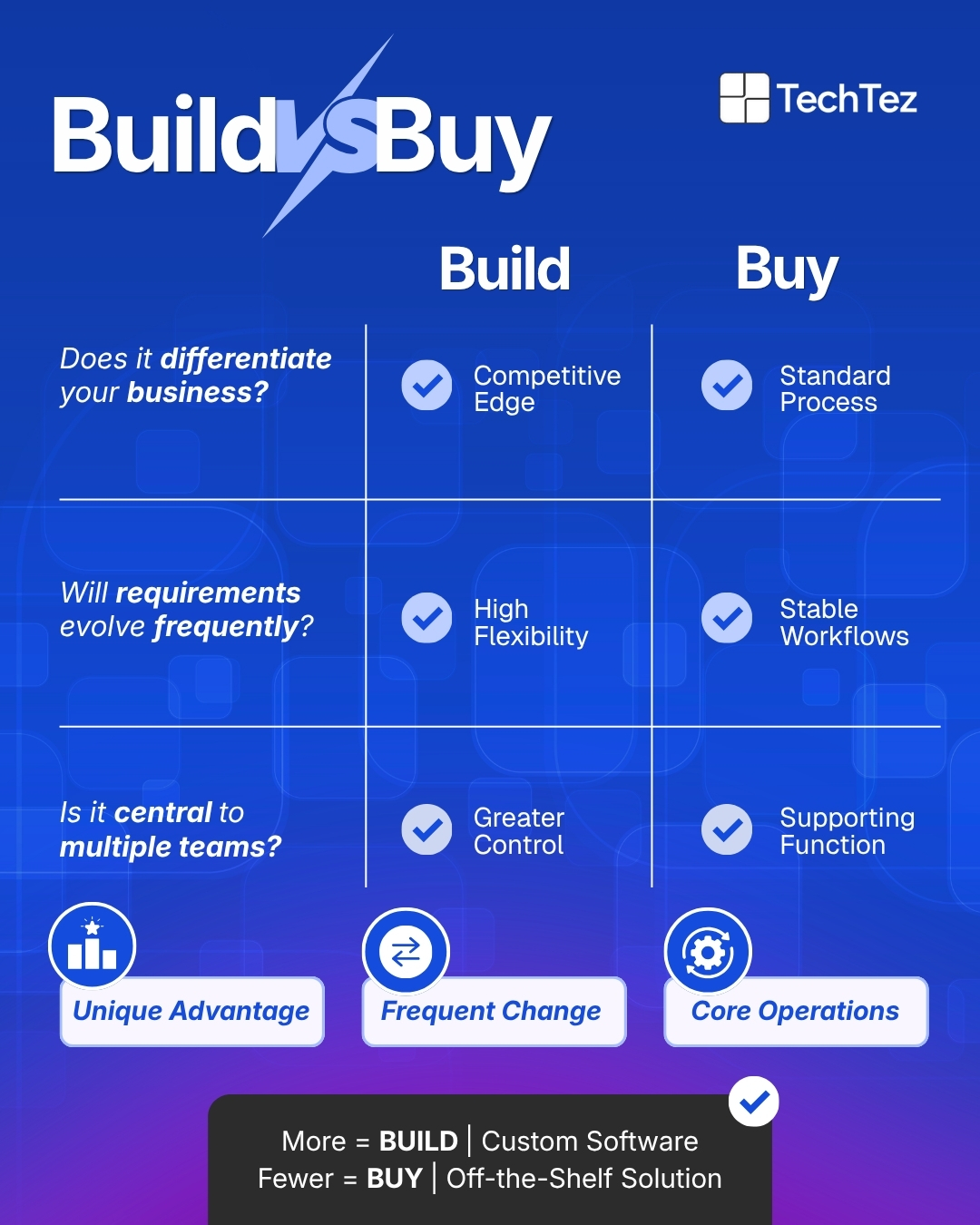
Off-the-shelf software works best in business areas where competitive differentiation is not a priority. Functions such as payroll processing, compliance management, accounting, procurement, and HR administration typically operate within standardized regulatory and operational frameworks. In these domains, accuracy, consistency, and compliance matter far more than uniqueness.
Building custom systems for such functions often introduces unnecessary cost, longer implementation timelines, and additional maintenance responsibility. Established SaaS platforms already embed industry best practices, frequent regulatory updates, built-in security protocols, and scalability features that would be expensive to replicate internally. Leveraging these tools allows organizations to reduce risk while maintaining operational efficiency.
Startups especially benefit from packaged solutions in their early growth stages. Their priority is achieving product-market fit, validating business models, and scaling quickly without heavy upfront investment. At this stage, speed and cost efficiency outweigh architectural customization.
Insight: Strategic allocation of engineering resources ensures teams focus on building capabilities that directly drive innovation and competitive advantage.
When Should CTOs Invest in Custom Software?
Custom software becomes valuable when business differentiation depends on unique processes. If your competitive advantage relies on specialized pricing models, dynamic customer journeys, workflow automation, or proprietary data handling, standardized tools may limit innovation.
Research from Forrester indicates that organizations investing in tailored digital platforms often experience significant improvements in process efficiency and operational alignment compared to those heavily dependent on adapted packaged tools.
Custom systems are particularly beneficial when:
- Processes evolve frequently
- Multiple departments require integrated workflows
- Data consistency is critical
- Vendor roadmaps do not align with business goals
In fast-moving markets, the ability to adapt quickly can determine long-term success.
The Hidden Costs of Off-the-Shelf Software
At first glance, SaaS solutions appear highly affordable and convenient. Subscription-based pricing models provide predictable monthly or annual costs, and implementation timelines are typically short compared to custom development. For growing businesses, this combination of speed and financial clarity is appealing. Teams can deploy tools quickly, begin operations almost immediately, and avoid heavy upfront infrastructure investments.
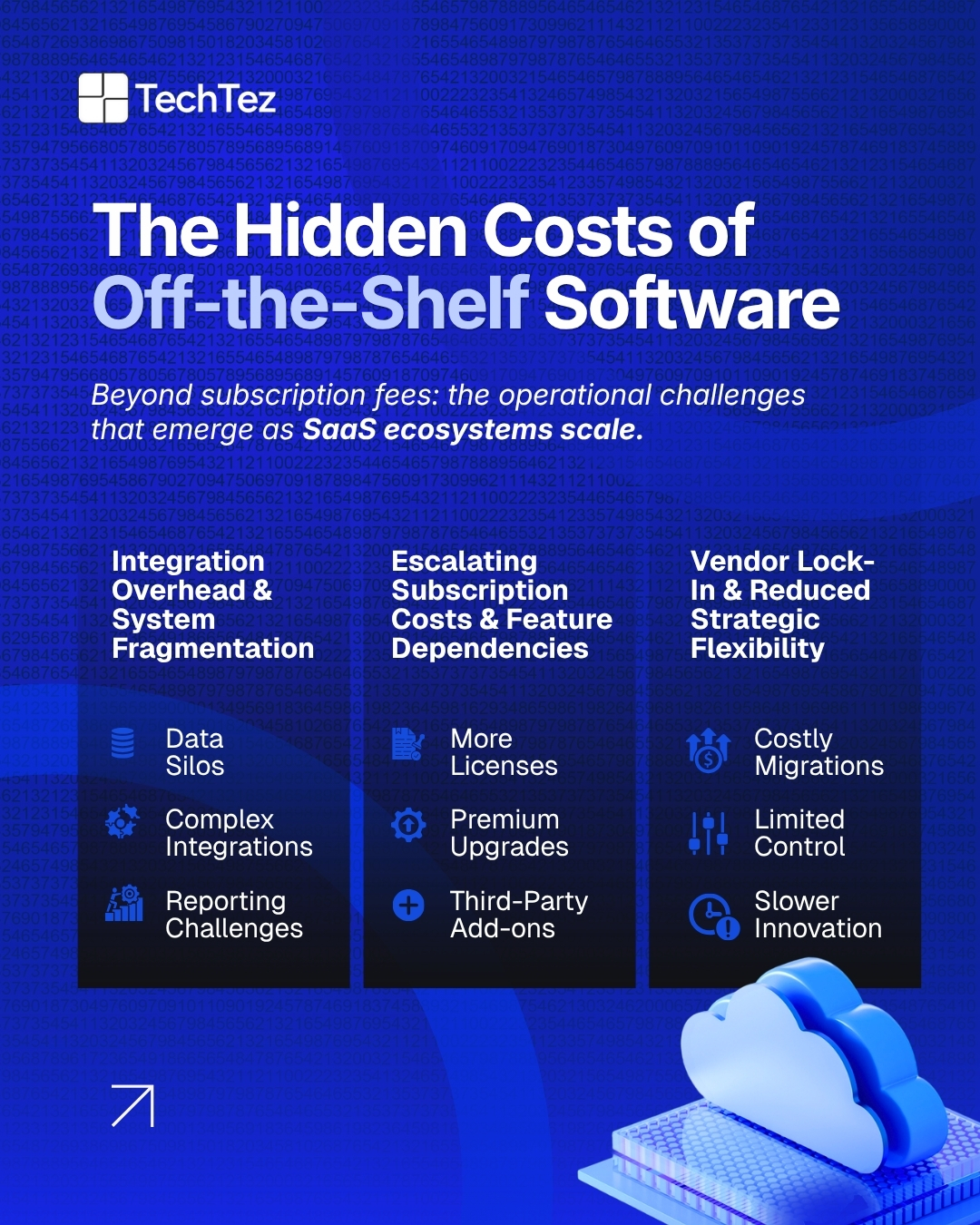
However, the long-term cost of SaaS extends far beyond licensing fees. As companies scale, they often adopt multiple platforms to meet expanding needs across sales, marketing, finance, operations, and customer support. While each tool addresses a specific requirement effectively, the collective ecosystem introduces integration challenges and operational dependencies that compound over time.
Over time, this fragmentation reduces agility. Even minor workflow updates may require coordination across several systems. Vendor lock-in further limits flexibility and negotiation leverage. Ultimately, the greatest hidden cost is not financial, it is operational rigidity that slows innovation and growth.
1. Integration Overhead and System Fragmentation
As organizations expand, SaaS ecosystems tend to grow organically rather than strategically. A CRM is added for sales, an automation platform for marketing, an accounting system for finance, and a helpdesk solution for support. Each platform works effectively in isolation, but rarely are they designed to operate as a unified system.
To bridge these gaps, companies rely on APIs, middleware tools, data connectors, and manual synchronization processes. Over time, integration becomes an ongoing maintenance task rather than a one-time setup. Even small updates in one platform can disrupt workflows in another. IT teams spend increasing amounts of time managing connections instead of focusing on innovation.
Fragmented systems also complicate reporting and analytics. When data lives across multiple environments, extracting accurate, real-time insights becomes challenging. Inconsistent data formats and duplicated records can reduce confidence in decision-making.
What initially appears to be flexibility through multiple tools gradually turns into structural complexity. The more platforms introduced, the harder it becomes to maintain operational clarity and system stability.
2. Escalating Subscription Costs and Feature Dependencies
While subscription pricing models seem predictable, long-term SaaS expenses often scale faster than expected. As businesses grow, they require more user licenses, higher storage capacity, advanced security features, and premium integrations. Many SaaS vendors operate on tiered pricing models, meaning access to critical features may require upgrading to higher-cost plans.
Over time, organizations may find themselves paying for bundled functionality they only partially use. Additionally, adding new integrations or automation capabilities often requires third-party extensions, further increasing costs. These incremental expenses accumulate quietly and are rarely visible in initial cost comparisons.
Beyond subscription fees, there are hidden costs related to training, onboarding new employees, and managing vendor contracts. Each additional platform requires user education and administrative oversight.
The financial impact is not always dramatic at first. However, as the number of systems grows, the cumulative expense becomes significant. What started as a cost-saving measure may evolve into a substantial operational budget commitment.
3. Vendor Lock-In and Reduced Strategic Flexibility
Vendor lock-in is one of the most underestimated risks of relying heavily on off-the-shelf software. Once a platform becomes deeply embedded into daily operations, switching providers becomes complex and costly. Data migration, workflow reconfiguration, retraining employees, and rebuilding integrations can disrupt business continuity.
As dependency increases, organizations lose leverage in pricing negotiations and roadmap influence. Vendors control feature updates, product direction, and pricing adjustments. If a vendor discontinues a feature or changes pricing structures, businesses have limited immediate alternatives.
This dependency also affects innovation speed. When product updates depend on vendor timelines, internal teams cannot move as quickly as strategic opportunities demand. Even minor feature requests may require waiting for official releases.
Ultimately, the largest hidden cost of vendor lock-in is reduced adaptability. Businesses become constrained by external decision-making cycles rather than their own strategic priorities. In fast-moving markets, this rigidity can significantly impact competitive positioning.
The Long-Term ROI of Custom Software
SaaS feels cheap at first: low setup cost, fast deployment, predictable monthly fees. That math breaks down as companies add more tools for sales, marketing, finance, and support. Each new platform needs its own integrations, training, and contract management, and those costs build up over time.
Custom Software ROI (%) = [(Cumulative SaaS Cost Avoided + Value of Efficiency Gains − Total Custom Development Cost) ÷ Total Custom Development Cost] × 100
For example: a company paying $15,000 a month across six SaaS tools breaks even on a $320,000 custom build in about 21 months. After that, every month saved on subscriptions adds directly to ROI, on top of the engineering time no longer spent maintaining integrations between disconnected systems.
Conclusion
The debate between custom software and off-the-shelf solutions is not about declaring one universally better than the other. It is about making intentional, strategic decisions based on your organization’s goals, growth stage, and competitive landscape. Every business has functions that require stability and standardization, and others that demand flexibility and innovation. The key is understanding the difference and allocating resources accordingly.
Buy stability where differentiation does not matter. Standardized systems for payroll, compliance, or accounting can reduce risk and save time. Build flexibility where your competitive advantage depends on unique workflows, customer experiences, or rapidly evolving processes. That is where ownership and adaptability create long-term value.
Technology ultimately determines how quickly your business can respond to change. The architectural decisions you make today influence scalability, innovation speed, and operational efficiency tomorrow. Choosing wisely ensures your organization accelerates with confidence instead of being constrained by its own systems.
TechTez Edge : Engineering Software That Scales
At TechTez, we specialize in building scalable, secure, and custom software solutions that are tightly aligned with business strategy. We design robust digital architectures that support long-term growth, performance, and adaptability. Our engineering-first approach ensures that every system we build is optimized for scalability, security, and seamless expansion as your business evolves.
We focus on cloud-native development, AI-driven automation, DevOps best practices, and deep system integrations that eliminate data silos and reduce operational friction. For example, in one recent case study, we helped a growing enterprise replace multiple disconnected SaaS tools with a unified custom platform. The result was improved workflow efficiency, centralized reporting, and faster feature deployment, significantly accelerating their operational agility.
Stop patching together SaaS tools that weren’t built to work as one system. Connect with TechTez and build a platform that scales with you.