

In 2026, many CIOs are confronting a stark new reality: cloud costs have exploded to become the second-largest expense for tech enterprises, surpassed only by payroll. This surge has made cloud cost intelligence a critical capability for enterprises, and it’s now a boardroom mandate, with 67% of CIOs ranking cloud cost optimization as a top priority.
A survey of CIOs found 83% overshot their cloud budgets by nearly 30% on average, underscoring the urgent need for smarter cost strategies. As IT leaders weigh AWS vs Azure cost strategies amid an ever-expanding cloud landscape, one lesson is clear: lasting savings require architecture-led optimization designing systems for efficiency as well as performance from day one. It’s not simply about trimming expenses; it’s about engineering a cloud environment where financial and technical goals align.
This strategic guide arms cost-conscious, architecture-aware decision-makers with the insights to turn rising cloud expenditures from a looming threat into a source of sustainable business value.
The Architect’s Eye Beyond the Price Tag
When finance leaders compare cloud platforms, the focus is often on pricing tables, invoices, and negotiated discounts. Their perspective is rooted in budgets and immediate cost visibility. Architects, however, approach the same question very differently.
Instead of asking which cloud is cheaper, architects ask cheaper for which workload, over what lifecycle, and under which governance model. Cost, in their view, is not a static number but a dynamic outcome shaped by design choices, scale behaviour, and operational constraints.
Key considerations architects evaluate include:
- Workload variability and scaling behaviour
- Predictability of costs versus elasticity of resources
- Data transfer patterns and locality requirements
- Integration with existing ecosystems and tooling
- Long-term total cost of ownership compared to short-term billing
The Illusion of Cloud Cost:
Cloud pricing models may appear straightforward consisting of compute rates, storage tiers, and data-egress fees, but real-world invoices often tell a different story. Two identical workloads can produce drastically different costs, driven less by vendor pricing and more by architectural inefficiencies. These include poorly configured autoscaling, idle or over-provisioned instances, and excessive cross-region data transfers. Costs are further inflated by bloated backups, misaligned logging retention policies, and orphaned resources that continue to consume budget without providing operational value.
AWS vs Azure: A Difference in DNA
While AWS and Azure both offer competitive pricing models, their underlying philosophies differ significantly. The real distinction isn’t in the rate cards, but in how each platform is designed to be used.
AWS: Granular Freedom & Modular Control
AWS emphasizes deep configurability and fine-grained control, making it ideal for performance-optimized workloads and highly distributed systems. It suits organizations with strong engineering-led cloud maturity that prefer building custom architectures and tuning resources at scale.
Azure: Integrated Governance & Enterprise Alignment
Azure is designed with enterprise integration in mind, particularly for Microsoft-centric environments. It offers unified management across identity, networking, and security, making it easier to govern complex systems. This approach reduces operational complexity, especially for regulated industries and hybrid workloads.
Who wins on cost?
Neither platform is inherently cheaper it depends on architectural intent. Two organizations can run the same workload on AWS and Azure and arrive at very different cost outcomes. One may optimize through automation and elasticity, while the other achieves efficiency through governance and policy enforcement.
In the end, the cheapest cloud is not the one with the lowest prices, but the one best aligned with your architecture and operating model.
Architecture: The Hidden Source of Cost Variability
The biggest driver of cloud overspending isn’t pricing its design debt. Most unexpected cloud costs stem from architectural decisions rather than provider rates.
Hidden cost traps arise when organizations run idle containers or poorly configured autoscaling, replicate data unnecessarily across regions, or implement overbuilt high-availability architectures without real ROI justification.
Costs also escalate when legacy on-prem systems are lifted and shifted without redesign, when storage classes are chosen incorrectly, or when networking and caching resources remain underutilized.
Ultimately, the most meaningful metric is not cost per CPU hour, but cost per architectural decision.
The Benchmark Shift: From Cost Cutting to Cost Intelligence
For years, the primary approach to cloud optimization was simple: cut the bill.
But the modern cloud demands a more strategic mindset today’s winning organizations focus on understanding the bill, not merely reducing it.
Cost Intelligence helps enterprises uncover why spending is increasing by identifying the root causes, understand where budget allocation should shift based on business priorities, and determine how architectural decisions translate into financial outcomes. It enables teams to balance performance with cost, rather than sacrificing one for the other.
The foundation of Cost Intelligence is built on predictive insights instead of reactive anomaly alerts, and policy-driven enforcement instead of manual cost reviews. It strengthens cross-team accountability across FinOps, DevOps, and Architecture, while ensuring real-time visibility aligned with business KPIs.
Because ultimately, savings without intelligence are temporary only intelligent architecture creates sustainable value
Cloud Cost Optimization Strategy: From Insight to Action
Gaining intelligence on cloud spending is only half the battle CIOs also need a cloud cost optimization strategy to act on those insights. A successful strategy blends financial governance, architectural best practices, and engineering culture changes.
Here are several strategic pillars of cloud cost optimization, supported by industry data and real-world results:
Establish FinOps and Cost Ownership:
Build a FinOps function or cross-team discipline that makes cost an everyone issue.
For example, assign cost owners for each product or team, set budgets or KPIs for cloud spend, and provide developers with real-time cost visibility. It’s telling that 59% of organizations now have a dedicated FinOps team (up from 51% a year prior) as they recognize the need for continuous cost oversight. When teams see the cost impact of their decisions (e.g. via dashboards or alerts integrated into deployment pipelines), behaviour changes naturally. Some enterprises even implement “cost as code “embedding cost checks into CI/CD so that deploying an inefficient query or an oversized instance triggers a review.
Rightsized and Rationalize Resources:
One of the quickest wins is eliminating obvious waste idle servers, overprovisioned storage, forgotten test environments.
According to research from Gartner, organizations lacking cloud optimization strategies waste as much as 55% of their cloud spend. In contrast, highly optimized environments can reduce that waste to as little as 15%. To bridge this gap, businesses should perform regular analysis of utilization metrics to downsize instances using tools like AWS Compute Optimizer or Azure Advisor.
Explore these Cost Optimization Strategies for Uncertain Times to learn how to implement these frameworks in your own infrastructure.
Automation is key here use scripts or cloud schedulers to shut off resources on schedules (for dev/test) and leverage autoscaling so you’re not paying for capacity you don’t need. Many organizations report 20–30% cost reductions in the first year of a FinOps program simply by cleaning up low-hanging fruit.
Optimize Cloud Architectures for Cost Efficiency:
Cloud architecture choices from the services you use to how you design for scaling have a profound impact on cost. Embrace cost-efficient design patterns: for instance, prefer serverless or managed services where possible to avoid paying for idle infrastructure (AWS Lambda/Azure Functions can be extremely cost-effective for intermittent workloads). Use container orchestration and Kubernetes autoscopes to pack workloads efficiently. Choose storage classes and database tiers that align performance with cost (e.g. archive infrequently used data to AWS Glacier or Azure Archive Storage).
Critically evaluate data transfer patterns: architect applications to minimize cross-region or cross-cloud data flows, since, as noted, data egress fees can silently balloon costs. A well-architected framework review (AWS’s Well-Architected or Azure’s Advisor) focusing on the cost optimization pillar is a great exercise to uncover architectural improvements. Ultimately, architectural maturity and cost efficiency go hand in hand as teams adopt cloud-native designs (microservices, stateless apps, event-driven processing), they often gain more granular control over scaling and spending.
Leverage Pricing Instruments and Discounts:
Take full advantage of the cloud provider’s cost-saving programs. This includes committing to usage for discounts – e.g. AWS Savings Plans/Reserved Instances and Azure Reserved VM Instances can each save 40–72% on compute. Use volume discounts and enterprise agreements if your usage is large (both AWS and Azure negotiate private pricing for big commitments). Also utilize spot instances or low-priority VMs for non-critical and batch workloads these can cut costs dramatically (70%+), albeit with the trade-off of possible interruptions.
For organizations with significant Microsoft license footprints, Azure Hybrid Benefit, as mentioned, provides huge savings by “BYOL” (bring your own license) to Azure. Similarly, AWS offers credits and custom pricing for migration projects don’t hesitate to engage your cloud account reps to find potential savings. Tracking and optimizing cloud contracts are now a core part of cost strategy; many CIOs treat cloud commitments like a portfolio to manage, ensuring they’re using all purchased capacity and renegotiating as needed.
Implement Continuous Cost Monitoring & Analytics:
Optimization is not a one-time project but an ongoing process. Invest in cost monitoring tools (native ones like AWS Cost Explorer, Azure Cost Management, or third-party cloud cost management platforms) that can send alerts when spend deviates from forecasts or when anomalies occur. Set up budget thresholds and get notified if, say, this months spend is 10% above trend. Use tagging or resource grouping extensively so you can attribute costs to owners (e.g. tag resources by application, environment, or team). Many enterprises now produce weekly or monthly cost reports for engineering leads, highlighting top cost drivers and savings opportunities.
Some are even embracing AI-driven cost insights, where machine learning analyses usage patterns to predict where future costs can be optimized. The mantra is “visibility drives accountability” when costs are transparent and tracked, it creates a feedback loop that encourages optimization.
The New Lens for Benchmarking
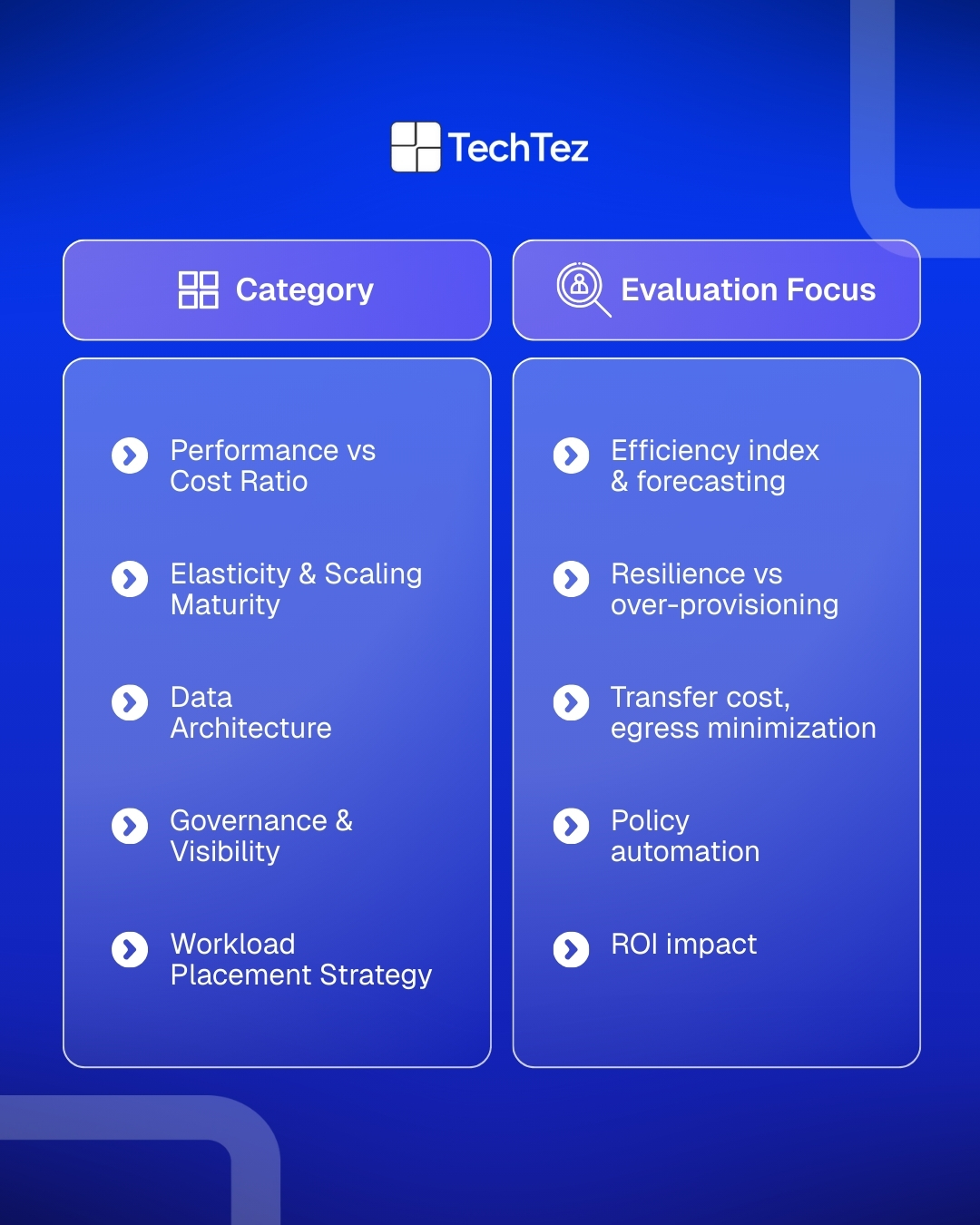
Today, benchmarking cloud environments is about more than comparing rate cards or price lists about evaluating architectural maturity. True cloud performance is measured by how well an architecture adapts to changing demand, enforces governance continuously, and detects anomalies before they show up on the invoice.
It also considers whether optimization decisions are automated or manual, and whether the system supports safe experimentation without risking unexpected costs. These factors provide a far more accurate picture of cost intelligence than raw pricing numbers alone.
Engineering for Predictability
In 2026, the most cost-efficient clouds aren’t necessarily the cheapest they’re the most predictable. Predictable cloud costs empower accurate financial planning, enable innovation without fear of unexpected billing spikes, support rapid scaling, and foster transparent collaboration between CFOs and CTOs.
Predictability arises from automated governance, disciplined architecture, intelligent workload placement, and AI-driven optimization. Cost surprises aren’t just financial, they reflect gaps in architectural design.
Perspective: Architecture as Strategy
Across global benchmarking programs, one truth consistently holds true: cost performance always follows architectural maturity. Organizations that design with intent consistently outperform those that attempt to optimize reactively after problems surface.
This is where TechTez’s Cloud Intelligence Approach creates measurable impact.
Through architectural benchmarking frameworks and governance-driven multi-cloud optimization,
TechTez enables smarter cloud decisions. With IntelligentOps automation and AI copilots, combined with continuous workload intelligence monitoring and unified financial and engineering observability, organizations gain clarity, alignment, and predictable cost outcomes.
The Architect’s Advantage:
AWS and Azure pricing models will continue to evolve with new instance types, discounts, and pricing incentives. But long-term cloud efficiency will not be determined by who offers the lowest rates on paper. It will belong to teams that understand cost as an architectural outcome, not a billing metric.
In 2026, the real question is no longer “Which cloud is cheaper?” but “Which cloud enables smarter architectural thinking?” the kind that supports elasticity, governance, automation, and continuous optimization.
The smartest cloud is not the one with the lowest monthly invoice. It is the platform that allows architectures to learn from usage patterns, adapt to changing demand, and sustain business value over time through intelligent design and automation.
Final Thoughts
In the era of AI-augmented operations, cloud benchmarking is no longer about who spends less, but who architects smarter. True efficiency comes from how well systems are designed to adapt, optimize, and govern costs at scale.
Whether on AWS, Azure, or hybrid environments, success depends on aligning architecture, automation, and governance into a single, cost-intelligent ecosystem.
TechTez helps enterprises benchmark with context, optimize with precision, and engineer cloud platforms for sustained business value.